
Saint Francis of Assisi and the Quiet Joy of Radical Simplicity

Saint Francis of Assisi still feels dangerous because he took the Gospel literally. Not politely. Not as a symbol. Not as something to admire from a carved wooden pew. He heard a call to give himself away, and he answered with empty hands.

Every year on October 4, his feast day arrives like a small bell in autumn. The air starts to cool. The light turns gold and slanted. The year begins its slow letting go. It feels right that Francis should meet us there, at the edge of harvest and surrender, reminding us that joy can come from having less, not more.
I think of him often when life grows noisy. When my attention scatters. When every object in the house seems to ask for care, updating, charging, replacing, storing. Francis stands there in his patched tunic, barefoot in the dust, and asks a question I do not always want to answer: What do you truly need to live with love?

Francis chose poverty when comfort was within reach
Francis was born in Assisi around the end of the 12th century, the son of a wealthy cloth merchant. His father, Pietro Bernardone, traded in fine fabrics. Francis grew up close to money, color, ambition, and the bright pleasures of youth. He was not raised to be invisible. He was raised to rise.
As a young man, he loved song, feasting, beautiful clothes, and the dream of glory. He wanted the kind of honor his world knew how to praise. War, status, romance, applause. The usual idols, only dressed in medieval clothing.
Then came the unraveling.
Francis experienced illness, war, captivity, and a spiritual restlessness that would not leave him alone. He began to pray in ruined churches. He encountered lepers, people his society feared and pushed away. At first, he recoiled. Then, in one of the great turning points of his life, he embraced what he had once avoided.
That embrace changed him.
There is the famous scene before the bishop of Assisi, when Francis renounced his father’s wealth. He stripped off even the clothes his father had given him and stood exposed, poor, and free. It is easy to make this moment picturesque, to turn it into stained glass. But imagine the humiliation. Imagine the family pain. Imagine the shock of it.
He was not making a charming lifestyle choice. He was breaking with the entire logic of possession.
Francis gave away everything because he believed love could not be hoarded. He embraced poverty, not because things are evil, but because things can become chains. He wanted nothing between himself and God. Nothing between himself and the poor. Nothing between himself and the created world, which he began to see as family.
Brother Sun. Sister Moon. Brother Fire. Sister Water.
This is the part of Francis that still unsettles me. I can admire generosity. I can praise humility. But Francis does not let me stop at admiration. He presses closer. He asks whether I own my possessions, or whether they quietly own me.
The birds knew something we forget
One of the most beloved stories about Francis tells of him preaching to the birds. He came upon them gathered in a field or along a roadside, depending on the telling, and he spoke to them as fellow creatures of God. They listened, the story says. They did not fly away.
Modern ears may smile at this. A saint sermonizing sparrows can sound sweet, almost childish. But I hear something deeper in it now.
Francis did not speak to the birds because he was sentimental. He spoke to them because he saw creation as alive with praise. He believed every creature existed in relationship. The birds were not props in a human drama. They were neighbors in a world charged with God’s presence.
That vision feels painfully urgent now.
We live surrounded by warnings from the natural world. Fires burn hotter. Storms arrive with new force. Species disappear before many of us ever learn their names. Much of modern life trains us to treat creation as background, resource, scenery, or inconvenience.
Francis saw kinship.

His tenderness was not weak. It was disciplined attention. He noticed what others passed by. He blessed what others used. He listened where others ruled.
The story of the birds reminds me that simplicity begins with seeing. To live simply is not only to buy less or keep a cleaner closet. It is to look at the world without the hunger to possess it. It is to receive the morning as gift, not product. It is to hear birdsong without needing to capture it, measure it, or turn it into content.
I fail at this all the time.
I reach for my phone before I reach for silence. I confuse being informed with being awake. I place small conveniences above larger loves. Then October 4 comes around, and Francis, with his birds and bare feet, tells me that another life is possible.
A poorer life, perhaps.
A freer one, too.
The stigmata was love written on the body
Near the end of his life, Francis withdrew to Mount La Verna to pray and fast. There, according to Christian tradition, he received the stigmata, the wounds of Christ impressed upon his body. His hands, feet, and side bore the marks of the crucifixion.
It is a mystery that resists easy speech.
Some approach it with devotion. Some approach it with skepticism. I do not think reverence requires us to pretend we can explain everything. The stigmata stands in Francis’s story as a sign of identification, a life so joined to Christ’s suffering love that even the body bore witness.
What moves me most is not the strangeness of the wounds, but the direction of his life before them. Francis had already spent years drawing near to pain. He cared for lepers. He chose the company of the poor. He surrendered comfort and reputation. His body had long been shaped by compassion before it was marked by mystery.
That matters.
Our culture often treats pain as something to avoid at any cost, unless it can be packaged as personal growth. Francis did not seek suffering for its own sake. He sought Christ, and that path led him toward those who suffered.
Radical simplicity is not self-improvement with a rustic filter. It is love with fewer hiding places.
This is where the counterargument comes in, and it deserves honesty. Most of us cannot, and should not, copy Francis in a literal way. People have children to feed, rent to pay, medical needs, aging parents, jobs, and responsibilities. Poverty chosen freely is not the same as poverty forced by injustice. Romanticizing deprivation can become cruel very quickly.
But Francis is not asking every person to abandon a home, family, or work. He is asking us to examine what we serve. He is asking whether comfort has made us numb. He is asking whether our “needs” have multiplied beyond recognition.
His life is extreme, yes. That is why it clarifies.
Like a bell struck in fog, Francis helps us hear what has been muffled.
His song still teaches us how to belong
Near the end of his life, when he was ill and nearly blind, Francis composed the Canticle of the Sun. It is one of the great poems of Christian spirituality, a song of praise for God through creation. Sun, moon, wind, water, fire, earth, forgiveness, suffering, even death, all find a place in the hymn.
The beauty of the canticle is that Francis did not write it from ease. He wrote it from weakness. He praised while his body failed. He sang when he could no longer enjoy the world in the way he once had.
That gives the poem its force.
It is one thing to bless Brother Sun when life feels warm. It is another to bless Sister Bodily Death when she stands near the door.
The canticle does not deny sorrow. It gathers sorrow into praise. It does not flatten creation into decoration. It names the world as a family of gifts. Every element has dignity. Every creature points beyond itself.

I wish I had that kind of praise in me more often.
My praise is usually conditional. I praise when plans work, when the house is peaceful, when the body behaves, when the news is bearable. Francis teaches a harder and brighter art: praise that does not wait for perfect conditions.
That may be the hidden joy of simplicity. When life is crowded with wants, gratitude has to fight for air. When life becomes simpler, even a cup of water can shine.
A saint’s day is a second birthday
I learned to love the Spanish tradition of celebrating a saint’s day, the día del santo, because it carries a tender idea: a name is not just a label. It is a connection.
In many Spanish-speaking families and communities, a person may celebrate not only a birthday, but also the feast day of the saint whose name they bear. Gifts may be small. Greetings may be simple. Sometimes it is just a phone call, a sweet, a blessing, a remembered name spoken with affection.
There is something beautiful in that. A birthday says, “You are alive.” A saint’s day says, “You belong to a story larger than yourself.”
For anyone named Francisco, Francesca, Francis, Fran, Paco, or another variation, October 4 carries that special glow. It becomes more than a square on the calendar. It becomes a little doorway into Assisi, into the roads where a merchant’s son became poor, into the fields where birds became a congregation, into the song where sun and moon became siblings.
Even for those of us who do not bear his name, the day can still ask something of us.
What if October 4 became a yearly practice of simplification? Not a dramatic purge. Not a performance. Just one honest gesture in the spirit of Francis.
Maybe:
Give away something useful that someone else needs more.
Take a walk without headphones and listen for birds.
Repair a relationship instead of winning an argument.
Eat a simple meal with gratitude.
Spend less for a day and notice what rises in the silence.
Pray, or sit quietly, for those who live without enough.
The día del santo tradition reminds me that holiness is not abstract. It attaches to names, kitchens, calendars, songs, and ordinary greetings. It enters the home through habit.
And habits, quietly repeated, shape the soul.
Radical simplicity is a form of resistance
I do not think Francis would be impressed by much of what we call success. He would not despise us for it. Francis was not a scold in the shallow sense. But I imagine his grief would be clear.
So much of modern life trains us to want without rest. We are told to upgrade, expand, collect, display, and compare. Even our inner lives get crowded. We track ourselves, brand ourselves, explain ourselves, and measure our worth against strangers.
Francis offers a different measure.
He tells us joy does not require excess. Freedom does not require applause. Wealth does not guarantee abundance. A person can own much and still be starving for peace.
This is why Saint Francis of Assisi remains more than a gentle figure in a garden statue. His tenderness has teeth. His simplicity critiques an economy of endless appetite. His poverty exposes our fear. His joy proves that less can become spacious when love fills the room.
To choose simplicity now is an act of hope.
It says the human heart is not made for permanent consumption. It says the earth is not merely raw material. It says the poor are not invisible. It says prayer can be stronger than noise.
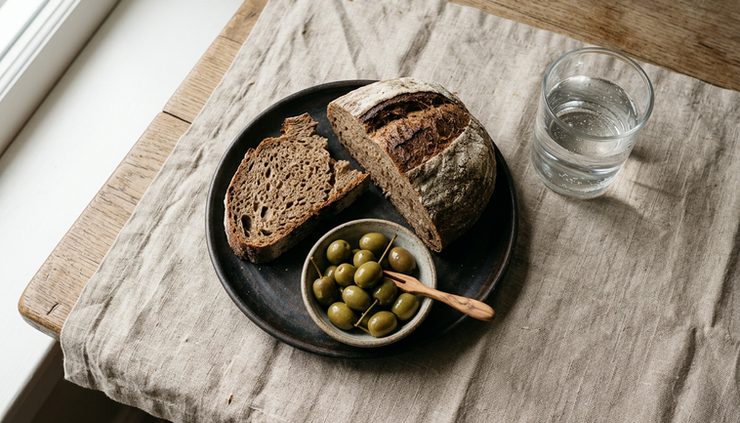
I do not live like Francis. Most days, I do not come close. But I need his witness the way a room needs an open window.
He reminds me to bless before I grasp.
To notice before I consume.
To give before I defend.
To sing before the dark has lifted.
On October 4, I like to imagine the saint of Assisi walking through our cluttered century with the same strange lightness. He would find the neglected ones first. He would greet the animals. He would ask us to lower our voices so we could hear the world praising God without us.
And maybe, if we were willing, he would teach us the quiet joy of empty hands.
Not empty because nothing matters.
Empty because love has room to arrive.
FRANCO ARTESEROS:::...


Comments