
El Camino de Santiago A Thousand Year Path of Reflection Under the Milky Way

Updated: 15 minutes ago
The Camino de Santiago still matters because it asks for the one thing modern life keeps trying to steal from us: attention. Not speed. Not comfort. Not proof that we have been somewhere. Attention.

The road to Santiago de Compostela is often described as a pilgrimage route across Spain, and that is true. It carries walkers, cyclists, seekers, doubters, believers, and the bone-tired toward the cathedral believed to hold the remains of Saint James. Yet the Camino is more than a line on a map. It is a long conversation between the body and the soul.
I believe its power comes from its plainness. You walk. You eat. You sleep. You rise again. The yellow arrows say, keep going. The scallop shell says, you are not the first. The stars say, you are smaller than you thought, and more held than you knew.

The Camino is ancient because it answers a current hunger
The Camino has carried pilgrims for more than a thousand years. By the Middle Ages, routes across Europe were guiding travelers toward Santiago de Compostela in Galicia, where the cathedral became one of the great pilgrimage destinations of Christian Europe. Kings walked parts of it. Monks sheltered strangers. Villagers fed people they would never see again.
That history matters, but not because age alone makes a place sacred. Old roads can become museums. The Camino has not. It stays alive because feet keep renewing it.
Each pilgrim adds a little pressure to the stones. Each prayer, complaint, blister, song, and silence joins the road without owning it. To walk there is to enter a current already moving. The route does not need to be invented by the person who arrives. It only needs to be accepted.
This is what makes the Camino different from ordinary travel. A vacation often asks, what do I want to see? A pilgrimage asks, what am I willing to release? The question may come gently. It may come after a bad night in an albergue, when someone snores like a small engine. It may come on a steep hill, when the horizon refuses to come closer. It may come while watching a stranger limp into town and then smile over a bowl of soup.
The road teaches through repetition. Step, breath, step, breath. The lesson is not hidden. It is underfoot.
The cathedral is the destination, but the road does most of the work
Santiago de Compostela has a force of its own. The old city gathers stone, rain, bells, and footsteps into a mood that is hard to name. For many pilgrims, the moment of arrival at the cathedral is moving beyond expectation. Some weep. Some sit still. Some take photographs, then put the camera away because the lens feels too small.
Still, the cathedral is not the whole point. If it were, a bus would do.
The Camino insists on arrival by slowly changing the one who arrives. It stretches time. It makes hunger honest. It turns water into a gift. It makes the weight of a backpack into a moral tutor.
I have come to think that the Camino’s genius is this: it makes meaning physical. Reflection is not only something that happens in a journal or a chapel. It happens in calves, shoulders, soles, and lungs. The body becomes a bell. Each mile rings it.
A pilgrim may begin with a clear reason: grief, gratitude, curiosity, faith, transition. After several days, that reason may shift. It may grow simpler. The road has a way of taking our speeches away. We arrive with explanations. We keep walking with a loaf of bread, a damp shirt, and the need to find a bed before evening.
That does not reduce the journey. It purifies it.

The yellow arrows are a theology of trust
The yellow arrows of the Camino are among the most beautiful acts of practical faith I know. They appear on stones, trees, curbs, walls, signposts, and the sides of quiet roads. They are not grand. They do not explain themselves. They simply point.
There is something deeply merciful about that.
In ordinary life, guidance often arrives wrapped in noise. Advice piles up. Opinions multiply. Screens keep asking for a reaction. On the Camino, an arrow gives one clear instruction: this way.
Not the whole way. Not the final answer. Just the next turn.
That is enough.
The arrows remind me that trust rarely appears as certainty. It comes as a small mark at a crossroads. It comes as a nudge when the road splits and doubt wakes up. It comes as a flash of yellow on a rain-dark wall.
The scallop shell carries a related wisdom. It is the symbol most closely tied to the Camino, worn on packs, carved into stones, printed on signs, and hung from walking staffs. Its grooves fan outward, then draw back toward one point. So do the many Camino routes. So do the many reasons people walk.
The shell is also humble. It belongs to the shore, to salt, to hands that collect what the sea leaves behind. As a pilgrim symbol, it says that identity does not need to be loud. A shell tied to a backpack can speak quietly: I am on the way.
Walking under the Milky Way changes the size of your questions
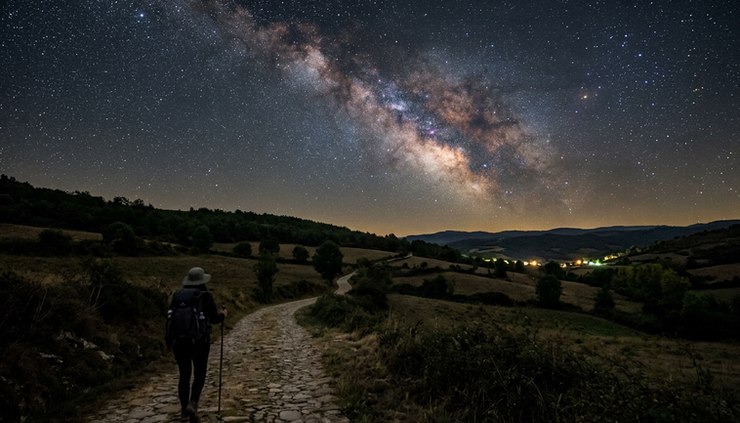
There are nights on the Camino when the sky seems to open like a dark book. Away from heavy city light, the Milky Way can appear as a pale river overhead. The old name for the Camino has often been tied, in legend and imagination, to the field of stars. Whether one reads that literally or poetically, the connection feels right.
To walk beneath the Milky Way is to feel the road above and below at once.
The path underfoot is gravel, mud, stone, asphalt, dust. The path overhead is light from distant stars, reaching across years no human hand can measure. Between them is the pilgrim, small, sore, breathing.
That smallness is not an insult. It is relief.
Many of our burdens grow heavy because we imagine ourselves at the center of everything. The night sky corrects us without cruelty. It says, your sorrow is real, but it is not the whole sky. Your joy is real, but it is not the whole sky. Your plans, fears, regrets, and hopes are sparks in a wider dark.
Under stars, reflection becomes less like self-analysis and more like listening. The world does not answer in sentences. It answers in frost on grass, a dog barking from a farm, the hush before dawn, the soft scrape of boots.
That is why I resist calling the Camino only an adventure. Adventure can still feed the ego. Pilgrimage asks the ego to loosen its grip.
Saint Francis understood that simplicity is not emptiness
The spirit of Saint Francis belongs naturally beside the Camino. Francis is remembered for poverty, humility, kinship with creation, and the joy of having less in order to love more. His way was not romantic comfort. It was a hard simplicity, chosen with tenderness.
The Camino teaches a similar lesson through the weight of a pack.
At first, a pilgrim may pack as if preparing for every possible future. Extra clothes. Extra books. Extra fear. The road soon conducts its inventory. Every unnecessary item becomes a question pressing into the shoulders.
Why carry this?
The question does not stay inside the backpack. It moves inward.
Why carry the old insult? Why carry the need to be admired? Why carry the version of yourself that no longer tells the truth? Why carry the restless hunger to be elsewhere?
Simplicity, in the Franciscan sense, is not a bare room with no music. It is the freedom to receive the day as gift. Bread tastes better. Water becomes bright. A field of sunflowers can feel like a choir. Even fatigue can become honest company.
This is not an argument against possessions in some harsh or theatrical way. It is a defense of enough. The Camino gives enough in daily portions. Enough path for the morning. Enough shade for a pause. Enough conversation for the heart to remember warmth. Enough silence for the mind to settle.
To walk like that is to practice trust with the whole body.
The main criticism is true, but it does not defeat the pilgrimage
Some people say the Camino has become too popular. They are not entirely wrong. Certain stretches can feel crowded in high season. Some towns depend on the pilgrim economy. Souvenirs appear where silence once might have been more common. Not every person on the route walks for spiritual reasons.
Yet I do not think this empties the Camino of meaning.
Pilgrimage has always been human, which means it has always included mixed motives. Medieval pilgrims were not all saints floating from shrine to shrine. They were tired bodies with needs, fears, debts, hopes, and appetites. They bought food. They sought lodging. They got lost. They complained.
A road does not lose its soul because imperfect people walk it. That is how it gets one.
The better question is not whether the Camino is pure. No living tradition is pure in that fragile sense. The better question is whether the Camino still has the strength to call people back to attention, humility, and wonder.
I believe it does.
Even on a busy day, the road can find a quiet place inside a person. Even beside a café full of packs and poles, someone may feel a burden lift. Even after a crowded final approach to Santiago, a pilgrim may stand before the cathedral and understand that arrival is not possession.
The Camino remains powerful because it does not require ideal conditions. It works with dust, rain, hunger, strangers, sore knees, and imperfect hearts.

The Camino is a road, but also a way of seeing
What stays with me most is not one famous view or one perfect dawn. It is the way the Camino rearranges value.
A clean pair of socks becomes a blessing. A bench in the shade becomes hospitality. A stranger’s “Buen Camino” becomes a small sacrament of encouragement. The day is no longer conquered. It is received, step by step.
That is the opinion I return to: the Camino matters because it teaches a form of freedom that comfort alone cannot give. It does not flatter us. It does not entertain us at every turn. It asks us to become available to the world again.
The thousand-year path to Santiago de Compostela keeps gathering people because the human need it serves has not disappeared. We still need roads that slow us down. We still need symbols simple enough to follow when life feels tangled. We still need nights under a sky wide enough to quiet our pride.
The yellow arrow says, this way.
The scallop shell says, many roads can lead to one holy meeting.
The Milky Way says, lift your eyes.
And somewhere between the dust and the stars, the pilgrim learns the ancient art of becoming simple enough to continue.
VCF DIME NOVEL:::...
FRANCO ARTESEROS:::...


Comments