
El Cid Beyond the Legend Was Rodrigo Diaz de Vivar the Real Hero

El Cid sounds like the kind of hero a country invents when it needs a clean story. Sword in hand. Cross on his banner. Loyalty in his heart. Enemies in front of him. Victory waiting at the end.

The real man was messier, and much more interesting.
Rodrigo Díaz de Vivar was a Castilian knight, an exile, a warlord, a mercenary captain, and eventually the ruler of Valencia. He fought for Christian kings, yes. He also fought for Muslim kings. He made enemies on both sides of the religious border and allies on both sides too. He could be loyal, ruthless, practical, brilliant, and self-serving, sometimes all in the same chapter.
That is what makes him worth talking about. The legend gives us a hero. History gives us a person.

The poem made El Cid simple because legends need clean lines
Most people meet El Cid through legend before they meet Rodrigo Díaz.
The great epic poem, The Poem of the Cid, shows him as the perfect wronged hero. He is loyal to King Alfonso VI of León and Castile, even when the king exiles him. He suffers disgrace, wins wealth and honor through battle, protects his family, and rises from shame to glory. It is a deeply satisfying story.
It also behaves like a story.
The poem smooths out the rough parts. It takes a man who lived in a tangled political world and turns him into a model of Christian knighthood. It gives his life a shape that feels almost too good to be true: exile, struggle, vindication.
You can see why that version lasted. Medieval audiences loved a hero who could lose everything and then win it back through courage. Later generations loved him even more because he seemed to fit a national story. El Cid became a symbol of Spanish Christian resistance during the long struggle between Christian and Muslim powers in Iberia.
But Rodrigo’s world was not a simple chessboard with Christians on one side and Muslims on the other.
It was a border world. Kings fought brothers. Muslim rulers hired Christian knights. Christian rulers made deals with Muslim rulers. Tribute money, personal ambition, family politics, and survival often mattered as much as religion.
That does not mean faith meant nothing. It mattered deeply. But politics did not always move in straight religious lines. Rodrigo Díaz knew that better than almost anyone.
Rodrigo Díaz came from the hard school of Castilian politics
Rodrigo was born in Vivar, near Burgos, probably around 1043. He came from the lower nobility, not the very top of the aristocratic ladder. That mattered. He had status, but not enough to coast. He had to earn attention.
He did.
As a young man, he served Sancho II of Castile. Sancho was one of the sons of Ferdinand I, whose lands were divided among his children. That split sparked conflict, because royal siblings rarely make peaceful neighbors when kingdoms are involved.
Rodrigo rose in this violent household politics. He became known as a powerful fighter and commander. His nickname, Campeador, means something like “battlefield champion.” It was not decorative. It came from a reputation earned in combat.
Then Sancho was murdered in 1072 during the siege of Zamora. His brother Alfonso VI took over Castile as well as León. Rodrigo now had to serve a king whose rise followed his old lord’s death. This is where legend starts to sharpen the drama.
Later stories claimed Rodrigo forced Alfonso to swear he had no part in Sancho’s killing. Whether that happened is doubtful. It makes for a great scene, though: the blunt warrior making a king swear innocence in public. You can practically hear the hall go silent.
True or not, Rodrigo’s relationship with Alfonso was tense. He stayed in royal service for a while, but he had rivals at court. He also acted with a boldness that did not always please the king.
Around 1081, Alfonso exiled him.
In the poem, exile becomes the test of a noble heart. In real life, it became an opening. Rodrigo did not fade away. He crossed into a different political world and made himself useful.

The exiled Christian knight served Muslim rulers
Here is the part the clean heroic version tends to rush past: Rodrigo Díaz went to work for the Muslim rulers of Zaragoza.
Zaragoza was one of the taifa kingdoms, the Muslim-ruled states that emerged after the collapse of the Caliphate of Córdoba. These kingdoms were often cultured, wealthy, and politically vulnerable. They fought each other. They paid tribute to Christian rulers. They hired skilled soldiers wherever they could find them.
Rodrigo was very skilled.
He served al-Muqtadir’s successors, especially al-Mu’taman and later al-Musta’in II. In their service, he fought Muslim rivals and Christian enemies. At times, that meant battling forces from Aragon or Barcelona. In one famous episode, he defeated and captured Count Berenguer Ramon II of Barcelona.
So picture that clearly.
The man later celebrated as a Christian national hero spent years as a military commander for Muslim kings, fighting other Christians when the job required it.
That fact does not make him a fraud. It makes him medieval.
People in Rodrigo’s world did not always define loyalty the way later nationalist stories do. A knight could serve a lord, take pay, protect a patron, and build his own power. Honor mattered, but so did income. Religion mattered, but so did opportunity. A man in exile still needed a future.
Rodrigo seems to have been very good at reading the room. He understood border politics. He knew how to negotiate, intimidate, raid, and command. He was not just a strong arm. He was a strategist.
This is also probably where the name El Cid comes from. It likely traces back to the Arabic sayyid, meaning “lord” or “master.” Think about that. One of the most famous labels attached to this Christian champion may have begun as an Arabic title of respect.
The legend presents him as a wall between worlds. His name suggests he lived between them.
Valencia was not just a victory, it was a test of rule
The biggest act of Rodrigo’s life came at Valencia.
Valencia was rich, strategic, and deeply contested. It sat on the Mediterranean coast, tied to trade, agriculture, and regional power. Whoever held Valencia mattered.
Rodrigo first became involved there through the politics of protection and influence. Local rulers, Alfonso VI, regional Muslim powers, and the North African Almoravids all became part of the struggle. The Almoravids had entered Iberian affairs as powerful Muslim reformers and military actors, and their arrival changed the balance.
Rodrigo saw his chance.
After a long pressure campaign and siege, he captured Valencia in 1094. This was no small raid. He did not simply win a battle and ride away. He took control of a major city and ruled it.
That is where his story becomes even more complicated.
Rodrigo, the Christian warlord, now governed a city with both Christians and Muslims. He needed soldiers, administrators, merchants, farmers, and taxpayers. He could not rule by poem. He had to rule by deals, punishments, compromises, and force.
Some Muslim inhabitants stayed. Some suffered. Some left. Christian settlers and clergy gained space. Rodrigo’s rule served his power and his faith, but it also depended on practical coexistence. Valencia could not function if he treated every Muslim resident only as an enemy.
This is the part that makes the real Rodrigo more interesting than the statue.
A statue can point a sword forever. A ruler has to decide who gets bread, who keeps land, who pays tax, who serves in the army, who can be trusted, and who might revolt.
Rodrigo held Valencia until his death in 1099. His widow, Jimena, tried to keep it afterward with help from Alfonso VI, but the position became impossible. In 1102, the Christians abandoned the city, and Valencia fell to the Almoravids.
So even his greatest conquest did not last in a simple way. It was dramatic, impressive, and temporary. That feels less like myth and more like life.

The real man does not fit inside the epic hero
The poem needs El Cid to be loyal above all. The historical Rodrigo was loyal, until he was not, or until loyalty no longer had a place to attach itself.
That sounds harsh, but it may be fair. He served Sancho. He served Alfonso. He served Muslim rulers in Zaragoza. He carved out power around Valencia. He fought for patrons, for honor, for wealth, for survival, and for his own lordship.
That mix can make modern readers uncomfortable. We like our heroes sorted neatly.
Was he a patriot? Not in the modern sense. Spain as a unified nation did not exist in his lifetime. There were kingdoms, counties, cities, taifa states, dynasties, and religious communities. Rodrigo was Castilian, Christian, noble, and ambitious. Those identities mattered. They did not add up to a modern flag.
Was he tolerant? That depends what we mean. He worked with Muslims. He ruled over Muslims. He also fought, besieged, and punished Muslim communities. Cooperation did not always mean kindness. Coexistence did not always mean equality.
Was he a mercenary? Sometimes, yes. But that word can be too small. He was more than a sword for hire. He became a power broker. By the end of his life, he was not merely serving rulers. He was one.
This is why El Cid Beyond the Legend Was Rodrigo Diaz de Vivar the Real Hero is such a tricky question. The “real hero,” if there is one, does not look like the polished champion from the poem. He looks like a tough, talented, dangerous man who knew how to survive in a world where survival itself required moral flexibility.
The poem asks us to admire him.
History asks us to understand him first.
Why the legend still matters
It would be easy to say the legend is false and the history is true. But that is too simple too.
The legend of El Cid tells us what later people wanted from him. They wanted a loyal vassal. They wanted a Christian champion. They wanted a man who could be wronged by a king and still remain noble. They wanted victory with a moral shape.
That matters because legends are not random. They are memories edited for meaning.
The real Rodrigo gave storytellers perfect material. He had exile, battle, royal tension, family drama, captured cities, famous enemies, and a name that already sounded larger than life. All the poem had to do was sand down the contradictions.
And to be fair, every age does this. We turn complicated people into symbols because symbols are easier to carry. A symbol does not argue back. A symbol does not demand footnotes.
But the human being underneath is usually more useful.
The real Rodrigo Díaz teaches us that medieval Iberia was not a simple story of two sides locked in permanent religious war. It was a place of violence, faith, ambition, trade, alliance, betrayal, and shared space. It was a world where a Christian knight could earn an Arabic honorific, fight for a Muslim ruler, then conquer a Muslim city and govern a mixed population.
That does not make him a modern model of tolerance. It makes him a real figure from a real border society.
And maybe that is why he still holds our attention. The perfect hero is easy to admire, then forget. The complicated one stays with you.
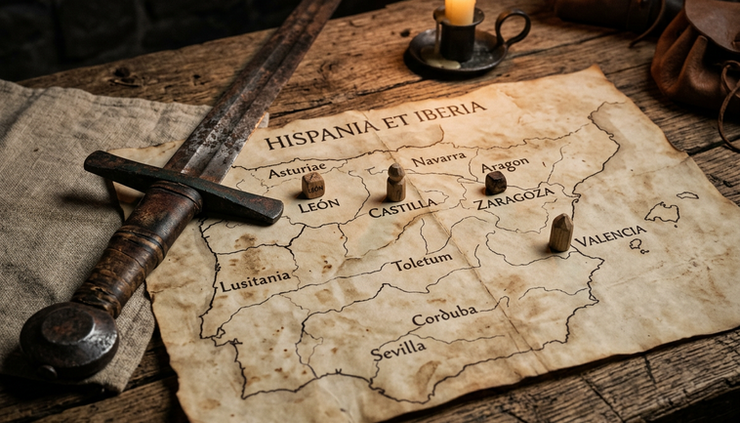
The hero and the man are still arguing
El Cid the legend rides in a straight line. Rodrigo Díaz de Vivar moved through a maze.
He was brave, but not pure. Loyal, but not simple. Christian, but willing to serve Muslim masters. A conqueror, but also a ruler who had to live with the people he conquered. A hero in poetry, and a problem in history.
That does not make the legend worthless. It makes it incomplete.
If anything, the real story gives him more weight. A simple hero can inspire. A complicated hero can teach. Rodrigo’s life reminds us that history rarely hands us clean characters. It gives us people shaped by pressure, chance, belief, hunger, pride, and fear.
The poem turned him into what people needed him to be.
History leaves us with the harder and better question: who gets to decide who the hero was?
VCF NOVELS:::.... EL CID::
FRANCO ARTESEROS:::...


Comments