
Spaghetti Western Origins to Evolution The European Myth of the Wild West
- Franco Arteseros
- 1 day ago
- 9 min read

Updated: 2 hours ago
A black hat cuts across a white sky. Boots grind into dust. Somewhere beyond the frame, a whistle rises like a warning from a ruined churchyard. The town looks American at first glance, with hitching posts, saloon doors, and a main street baked hard by the sun. Then the illusion begins to shimmer.

The mountains are not in Arizona. The dust is Spanish. The faces are Italian, German, French, Mexican, American, and Yugoslavian, often dubbed into another language after the cameras stop rolling. The West has crossed the Atlantic, shed its clean frontier myths, and returned as something harsher, stranger, and more operatic.
That is the spell of the Spaghetti Western. It did not simply copy Hollywood. It rebuilt the American West from European memory, postwar anxiety, genre hunger, and industrial nerve. From Rome soundstages to the Tabernas Desert, filmmakers created a cinema of squinting eyes, moral rot, gunfire, silence, and music that seemed to come from the desert itself.

Spaghetti Westerns were born from postwar film hunger
The roots of the genre reach into post-World War II Italy, when the country’s film industry was rebuilding at speed. Rome’s Cinecittà studios became a major production hub. Italian filmmakers had skill, crews, equipment, and a deep appetite for popular genres that could travel beyond national borders.

Westerns had long been part of European movie culture. American westerns filled theaters, and their codes were easy to recognize: the duel, the sheriff, the outlaw, the frontier town, the galloping pursuit. Yet by the late 1950s and early 1960s, Italian producers saw a practical opportunity. A western could be made cheaply, sold widely, and dubbed for multiple markets.
This industrial setup mattered. Spaghetti Westerns were often low-budget, fast-moving, and built for export. A film might have an Italian director, a Spanish crew, a German distributor, a French co-producer, and an American actor whose name helped sell the poster. The resulting movies were less national products than European co-production machines.
Money shaped the style. Limited budgets forced directors to shoot with economy. A dusty street became a whole frontier. A face could replace a crowd. Silence saved dialogue. Music carried meaning. The genre’s famous intensity grew partly from constraint.
European filmmakers also viewed the West from a distance. They did not treat it as sacred national history. They treated it as mythic raw material. The clean hero of classical Hollywood often became a paid killer. The noble frontier town became a nest of greed. Law became another costume for violence.
Spain became the face of the European West

Spain gave the genre its most recognizable terrain. The province of Almería, especially the Tabernas Desert, offered light, space, and a dry severity that looked convincing on film. Its parched hills, ravines, and empty flats could stand in for New Mexico, Texas, Arizona, or the Mexican borderlands.
The reasons were artistic and practical.
Almería had a semi-arid climate with long stretches of reliable sun. Productions could shoot outdoor scenes with fewer delays. The land offered desert basins, rocky ridges, dry riverbeds, and distant mountains within reachable production zones. It gave directors a wide visual range without forcing them to move entire crews across continents.
Costs also mattered. Spain was cheaper than shooting in the United States. During the Franco era, international productions could find labor, extras, horses, construction teams, and official permissions at prices that suited the co-production model. Western towns were built, reused, redressed, and expanded. A single street might serve several films with new signs and fresh blood in the dust.
Almería did more than imitate the American West. It transformed it. The light was harder. The spaces felt less romantic. The emptiness carried a cruel edge. In these films, the desert was not a promise of freedom. It was a furnace where greed, revenge, and survival stripped people down to bone.

A historical timeline of dust and reinvention
The Spaghetti Western did not appear fully formed. It moved through experiments, a breakthrough, a commercial explosion, and a long afterlife.
Period | What changed | Key examples and tendencies |
Late 1950s to early 1960s | European producers test western formulas | Early Spanish, Italian, and German co-productions borrow Hollywood plots while searching for a marketable tone |
1963 to 1964 | The genre sharpens | Films such as Gunfight at Red Sands point toward the Italian western style, including early work by Ennio Morricone under a pseudonym |
1964 to 1966 | Sergio Leone changes the game | A Fistful of Dollars, inspired by Akira Kurosawa’s Yojimbo, turns Clint Eastwood into an international icon |
Mid to late 1960s | The Golden Era arrives | For a Few Dollars More, Django, The Good, the Bad and the Ugly, and Once Upon a Time in the West expand the genre’s scale and language |
Late 1960s to early 1970s | The form diversifies | Political “Zapata Westerns,” gothic westerns, snowbound revenge stories, and comic variations push the genre in new directions |
1970s | Decline sets in | Parody cycles, changing audience taste, television western fatigue, and the rise of crime and horror films reduce the genre’s power |
Later decades | The myth survives | Neo-westerns, samurai-western hybrids, action cinema, music videos, and games recycle its style and mood |
Sergio Leone did not invent European westerns, but he gave them a new grammar. With A Fistful of Dollars in 1964, he slowed time, enlarged faces, roughened morality, and fused the western duel with the ritual tension of opera. Clint Eastwood’s poncho-clad stranger arrived like a ghost with a cigar.
The genre then multiplied. Sergio Corbucci brought brutality and bleakness to Django and The Great Silence. Sergio Sollima mixed adventure with politics in films such as The Big Gundown. Damiano Damiani and others fused western action with revolutionary themes. A universe of bounty hunters, bandits, priests, soldiers, and double-crossers followed.
By the 1970s, the market weakened. The Trinity comedies starring Terence Hill and Bud Spencer drew huge audiences, but their playful tone also signaled a shift. What had once felt dangerous became familiar. Italian genre cinema moved toward crime thrillers, giallo, horror, and other forms. The Spaghetti Western faded as a production cycle, though its style never really died.
The aesthetic DNA was written in dust, silence, and eyes
A Spaghetti Western can often be recognized before a gun is fired. It has a visual code as distinct as a fingerprint.
The extreme close-up is central. Leone and other directors turned faces into maps of danger. Eyes twitch. Sweat beads. A scar becomes a plot point. The camera studies skin, stubble, teeth, and dust with almost religious attention. In classical Hollywood, the wide shot often celebrated the frontier. In the Italian western, the face became a battlefield.

Then come the long silences. Characters wait. The wind moves. A fly buzzes. A hand hovers near a revolver. These pauses stretch time until a simple duel feels cosmic. The viewer does not just watch action. The viewer feels the pressure before action.
Sun-bleached vistas create another layer. Towns look half-dead. Graveyards sit too close to the main street. Interiors are dim, grimy, and crowded with greed. The land feels ancient, almost indifferent to human schemes.
The violence is stylized rather than naturalistic. Gunshots arrive as punctuation marks after long build-ups. Bodies fall in choreographed bursts. Revenge drives the plot, but the moral effect is rarely clean. Victory often tastes like ash.
Operatic pacing ties it all together. These films move between stillness and eruption. A stare can last longer than a fistfight. A showdown unfolds like a ritual, with characters arranged as if on a stage. The genre’s power comes from this rhythm: waiting, watching, tightening, firing.

The sound signature made the desert sing
No discussion of the genre can avoid Ennio Morricone. His music did not decorate the image. It changed what the image meant.
Morricone’s scores for Leone used whistles, bells, whips, gunshots, wordless voices, electric guitars, trumpets, and choral surges. The result was both ancient and modern. A duel could sound like a church service, a rock concert, and an animal cry at once.

The famous whistling motifs acted like memory signals. They could announce a character before the character entered the frame. Electric guitars gave the old west a modern pulse. Choral tension lifted violence into myth. Trumpets sometimes sounded heroic, but often with irony, as if the music itself knew the hero was compromised.
Other composers also shaped the genre, including Luis Bacalov, Bruno Nicolai, Francesco De Masi, and Carlo Rustichelli. Still, Morricone’s work remains the clearest sound emblem. He helped make silence louder. When the music stopped, the desert seemed to hold its breath.
This sonic world influenced far more than film scores. It entered rock music, hip-hop samples, commercials, animation, and video games. A single whistle over a tremolo guitar still conjures dust, danger, and a figure standing alone at the edge of town.
The characters were heroes with the heroism scraped off
Spaghetti Westerns are crowded with archetypes, but they are rarely simple.
The anti-hero stands at the center. This figure may rescue a town or avenge the dead, but the motive is often money, survival, or private injury. Clint Eastwood’s Man with No Name became the model: quiet, sharp, unreadable, and morally flexible.

The bounty killer follows close behind. Unlike the honorable lawman of older westerns, this character turns death into a trade. The bounty hunter knows the price of every face on a wanted poster. Justice becomes a receipt.
Corrupt sheriffs and officials reveal the genre’s suspicion of institutions. Badges do not guarantee virtue. Banks, armies, churches, and town councils often serve greed or violence. In many films, authority only means better weapons.
The tragic revolutionary appears in the political westerns. These characters fight empires, landlords, armies, and betrayal. They may be Mexican rebels, peasant leaders, or reluctant insurgents. Their stories bring the genre closer to debates about class, colonial power, and liberation movements of the 1960s.
Women in the genre were too often written within narrow limits, as widows, victims, saloon workers, or objects of revenge. Some films gave them more steel and agency, but the genre remained marked by the gender limits of its era. Modern viewers can admire the craft while seeing those limits clearly.
The global impact moved in every direction
Spaghetti Westerns were born from global exchange, then fed that exchange back into world cinema.
Japan was there from the beginning. Kurosawa’s Yojimbo helped shape A Fistful of Dollars, which then influenced later action and samurai-western hybrids. Decades later, films such as Takashi Miike’s Sukiyaki Western Django made the exchange explicit, mixing Japanese and western codes with playful excess.
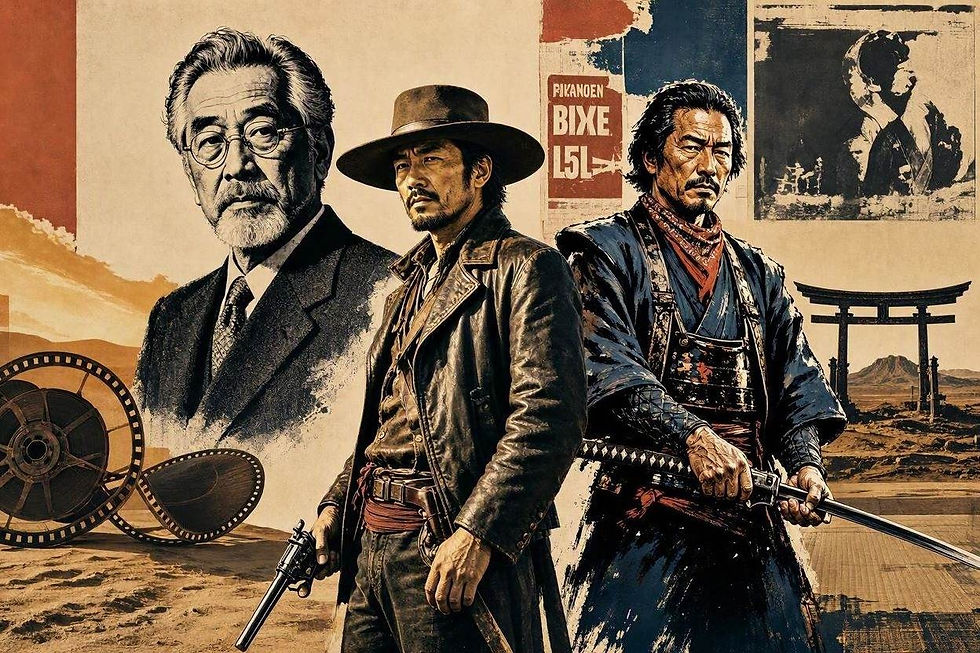
American cinema absorbed the shock. Clint Eastwood carried the style into his own directing career, especially in darker revisionist westerns. Sam Peckinpah’s violent ballets shared some of the same appetite for slow motion, moral decay, and frontier collapse, though his path was distinct. Later filmmakers drew from the Italian style with open affection.
Mexico shaped the genre’s politics and imagery, especially through border stories and revolutionary settings. The “Zapata Western” used Mexican Revolution backdrops to stage arguments about power, betrayal, and solidarity. These films were often European fantasies of Mexico, but they still changed how westerns handled politics.
Brazil found related energy in its own cinema of bandits, backlands, and mythic violence. Films tied to cangaceiro stories and the sertão, including works by Glauber Rocha, did not simply imitate Spaghetti Westerns. They shared a taste for harsh terrain, outlaw legends, and political allegory.
Modern neo-westerns keep borrowing the grammar. Quentin Tarantino uses long ritualized standoffs, Morricone cues, revenge structures, and sudden violence. Robert Rodriguez channels border-town pulp, guitar-case mythology, and stylized gunfighter cool. Video games such as the Red Dead Redemption series also carry traces of Leone’s pacing and the Italian western’s melancholy grandeur.

FAQ
Why are they called Spaghetti Westerns?
The name began as a nickname for westerns produced mainly by Italian filmmakers. It was once used dismissively, but it is now a common term for one of the most influential film movements in genre cinema.
Was Sergio Leone the first Spaghetti Western director?
No. European westerns existed before Leone’s breakthrough. His films changed the scale, style, and global reputation of the genre, especially after A Fistful of Dollars.
Why did so many films shoot in Spain instead of Italy?
Spain offered convincing desert terrain, dependable sunlight, lower production costs, and reusable western town sets. Almería and the Tabernas Desert became especially important.
What makes Ennio Morricone’s scores so recognizable?
Morricone blended whistles, electric guitars, bells, chanting voices, trumpets, and unusual percussion. His music gave each showdown a ritual charge and made the genre sound unlike classical Hollywood westerns.
Are Spaghetti Westerns still influential today?
Yes. Their close-ups, anti-heroes, revenge plots, stylized violence, and music cues still shape modern westerns, action films, video games, and directors such as Tarantino and Rodriguez.
The VCF myth engine of the European West
Spaghetti Western Origins to Evolution The European Myth of the Wild West is more than a film history topic. It is a study in how myths get manufactured, exported, broken, and rebuilt.

The genre fused art and industry with rare force. Producers needed sellable movies. Directors wanted expressive freedom. Composers invented new sound worlds. Actors crossed borders. Spanish deserts became American borderlands. Italian studios turned shortage into style. The result was a Virtual Creative Factory of dust, dubbing, music, faces, and myth.
That is the VCF myth-engine lesson: culture does not only preserve legends. It remixes them under pressure. The Spaghetti Western took America’s frontier dream, filtered it through European trauma and craft, and handed back a harsher vision. In that vision, the West was no longer clean. It was cracked, theatrical, political, and unforgettable.

The rider still crosses the desert. The whistle still rises. The camera still waits for the eyes to move.

Franco Arteseros:::...


Comments