
Science Fiction and Science From Origins to Tomorrow
- Franco Arteseros
- 12 hours ago
- 7 min read

Updated: 3 hours ago
A rocket on a page can change the way a laboratory feels. A laboratory discovery can change the shape of a rocket on the next page.

Science and science fiction have never lived in separate rooms. They pass notes through the wall. One builds instruments, equations, engines, medicines, cameras, and satellites. The other asks what those things do to memory, power, fear, wonder, bodies, cities, and the future.
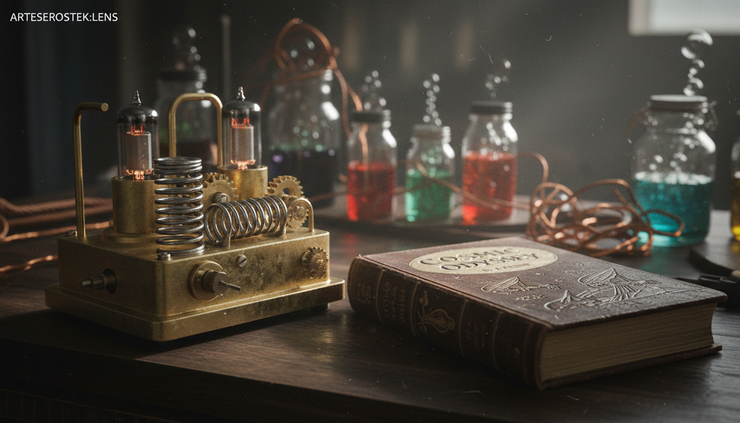
Seen through the ARTESEROSTEK:LENS, science fiction is more than prediction. It is a focusing device. It bends light from the past, sharpens the present, and throws possible tomorrows onto the wall. Some images are bright. Some are warnings. The best ones refuse to stay fictional for long.

Science fiction began before rockets had names
Science fiction did not appear fully formed with spaceships and laser pistols. Its roots reach into myth, satire, travel writing, natural philosophy, and the early modern hunger to explain the universe.
Ancient stories imagined journeys to the moon, mechanical beings, underworlds, flying machines, and gods with powers that often resemble advanced technology. These were not science fiction in the modern sense, but they show a lasting human habit: when people encounter mystery, they build stories around tools, bodies, and worlds that exceed known limits.
The genre began to take a clearer shape when scientific thought became a public force. The Scientific Revolution changed how people understood nature. Telescopes, microscopes, and experiments made the invisible feel reachable. New instruments did not only produce data. They produced a new kind of imagination.
In 1818, Mary Shelley’s Frankenstein gave that imagination one of its defining works. Shelley did not write about a magical curse. She wrote about experiment, ambition, responsibility, and the emotional life of a being made by human hands. The novel asks a question that still drives the genre:
If science gives us the power to create, who carries the burden of care?
That question sits beneath artificial intelligence stories, cloning stories, robotics stories, and many tales about biotechnology. Shelley’s creature is not just a monster. It is an ethical mirror.
By the late 1800s, Jules Verne and H. G. Wells opened two major paths. Verne leaned toward engineering dreams. In works like Twenty Thousand Leagues Under the Seas and From the Earth to the Moon, he made machines feel plausible, almost buildable. Wells leaned toward social and biological shock. The Time Machine, The War of the Worlds, and The Invisible Man turned scientific ideas into pressure tests for civilization.
Verne asked, “What could we build?” Wells asked, “What would that do to us?”
Science fiction has lived between those questions ever since.
Scientific advances keep changing the stories we tell
Every era gives science fiction new machinery and new anxiety. The genre tracks scientific change not as a passive record, but as a nervous system.
In the early 20th century, electricity, radio, aviation, and industrial chemistry altered daily life. Magazines such as Amazing Stories, founded by Hugo Gernsback in 1926, helped popularize what many readers came to recognize as modern science fiction. The stories often celebrated invention. They imagined gadgets, intelligent machines, space travel, and heroic problem solving.
Some of those tales now feel naive. Others still sparkle with raw excitement. Their central belief was powerful: science could open doors that had been sealed for all previous generations.
Then came the atomic age.
After World War II, nuclear physics changed both science and public fear. Science fiction absorbed the mushroom cloud. Stories about radiation, mutation, fallout, alien invasion, and ruined futures became a way to process power that seemed almost mythic, yet came from real equations and real laboratories.
The Space Age brought a different pulse. Satellites, rockets, moon landings, and planetary probes gave writers new textures. Space was no longer only a dreamscape. It had telemetry, dust, gravity wells, orbital mechanics, and government budgets. Arthur C. Clarke, Isaac Asimov, and Robert A. Heinlein helped define a period when scientific literacy and narrative ambition often traveled together.
Clarke’s Rendezvous with Rama treats wonder as a disciplined act of observation. Asimov’s robot stories turn engineering into moral logic, especially through the famous Three Laws of Robotics. Heinlein’s work often tied technology to politics, liberty, militarism, and social structure.
Later, computers changed everything again.
Cyberpunk rose from networks, corporate power, punk aesthetics, and the first sense that identity could leak into machines. William Gibson’s Neuromancer did not predict the internet in a literal one-to-one way. Its force came from mood and metaphor. It made cyberspace feel like a place before most people had experienced networked life as a place.
That is one of science fiction’s great strengths. It often predicts the emotional weather of technology better than the exact device.
Biology reshaped the genre too. Genetics, cloning, neuroscience, pandemics, ecological collapse, and synthetic life gave writers new questions. Ursula K. Le Guin used anthropology and social science to question gender, power, and belonging. Octavia E. Butler wrote about adaptation, hierarchy, bodily vulnerability, and survival with rare force. Her Parable novels feel painfully close because they understand that the future arrives through climate, politics, economics, and human behavior at the same time.
Recent science fiction has turned toward climate systems, machine learning, surveillance, Mars settlement, quantum speculation, and the ethics of intelligence. The tools keep changing. The deeper subject remains the same: science gives humans reach, and reach always has consequences.
The authors who built the genre also argued with it
Science fiction has no single parent and no single mission. Its key authors shaped the genre by expanding what counted as science, what counted as fiction, and who counted as human.
A few names mark major turns:
Author | Work or contribution | What changed |
Mary Shelley | Frankenstein | Made scientific creation an ethical drama |
Jules Verne | Voyages of engineering and exploration | Linked technical detail with adventure |
H. G. Wells | Time travel, alien invasion, invisibility | Used science to expose social fragility |
Isaac Asimov | Robot stories and Foundation | Connected logic, systems, and history |
Arthur C. Clarke | Space exploration and cosmic mystery | Made awe feel scientifically grounded |
Ray Bradbury | The Martian Chronicles, Fahrenheit 451 | Brought lyrical dread to technology and culture |
Ursula K. Le Guin | The Left Hand of Darkness, The Dispossessed | Treated society itself as an experiment |
Octavia E. Butler | Kindred, Parable of the Sower, Xenogenesis | Centered power, biology, race, and survival |
Stanisław Lem | Solaris | Challenged human-centered ideas of intelligence |
Liu Cixin | The Three-Body Problem | Renewed cosmic-scale speculation for global readers |
This list is not a monument. It is a map with missing roads. Science fiction also grew through pulp editors, fan communities, translators, film directors, comic artists, television writers, and game designers. It grew through works outside the English-speaking world, through Afrofuturism, feminist science fiction, Indigenous futurisms, Japanese cyberpunk, Soviet and Eastern European speculation, and many other streams.
The ARTESEROSTEK:LENS helps here because it resists a flat reading of progress. Through this lens, the genre looks less like a straight line from primitive fantasy to accurate prediction. It looks like layered glass.
One layer is invention. One is empire. One is fear. One is play. One is grief. One is mathematics. One is the body.
The richest works do not simply say, “Here is a new machine.” They ask what the machine sees when it looks back.

Science fiction changes how the public sees science
Science fiction shapes public perception by making science visible, emotional, and debatable. Many people first meet black holes, robots, genetic engineering, time dilation, space travel, or artificial intelligence through stories before they meet them in textbooks.
That can help science. A story can make a difficult idea feel alive. The idea of a generation ship, for example, turns astronomy, ecology, sociology, and engineering into a human question: what kind of society could survive a journey longer than a lifetime?
Science fiction also inspires careers. Astronauts, engineers, programmers, physicists, biologists, and designers have often named science fiction as part of their early imaginative fuel. A fictional communicator does not “cause” a smartphone, and a fictional robot does not “cause” robotics. The relationship is subtler. Fiction creates desire, language, and mental rehearsal. It gives people shapes to aim toward or avoid.
Yet the influence cuts both ways. Science fiction can distort science when spectacle replaces complexity. Faster-than-light travel, instant terraforming, humanlike AI, and clean one-step cures may work beautifully as narrative devices, but they can leave audiences with false expectations. Real science is slower, messier, and more collective than most plots allow.
The genre can also amplify fear. Nuclear mutants, killer robots, alien contamination, and runaway labs can become cultural shorthand for scientific danger. Sometimes that fear is useful. It pushes ethical debate into public view. At other times, it turns uncertainty into panic.
The best science fiction does not ask the public to worship science or reject it. It invites a more mature stance: curiosity with memory, ambition with restraint, wonder with accountability.
That stance matters now. Artificial intelligence systems write, sort, recommend, identify patterns, and make errors at scale. Climate science describes futures that depend on policy and behavior. Gene editing raises questions about medicine, inequality, disability, and design. Space exploration now includes national agencies, private companies, planetary protection debates, and renewed interest in the moon and Mars.
Science fiction gives these topics a rehearsal space. It lets society run thought experiments before reality hardens.
Tomorrow will need better questions, not just better predictions
The shallow way to judge science fiction is to ask whether it “got the future right.” That test misses the point.
Science fiction did not matter because it predicted every machine with perfect accuracy. It mattered because it trained culture to imagine consequences. A story can fail as prophecy and succeed as philosophy. It can get the gadget wrong and get the human reaction exactly right.
The ARTESEROSTEK:LENS frames the future as a field of refractions. Science sends out a beam: a new theory, a new instrument, a new capacity. Fiction catches that beam and splits it into colors. Who benefits? Who pays? What becomes normal? What becomes sacred? What becomes disposable? What becomes possible to love?
Tomorrow’s defining science fiction may not center only on faster ships or smarter machines. It may center on repair, limits, care, adaptation, and coexistence. It may ask what intelligence means when it is not human. It may ask what progress means on a damaged planet. It may ask whether survival without justice deserves the name.

Science fiction and science keep changing each other because both begin with disciplined imagination. One asks, “What is true?” The other asks, “What if this truth enters a life?”
Between those questions, the future starts to take shape. Not as a fixed destination, but as a set of choices waiting for language, courage, and care.

FRANCO ARTESEROS:::...


Comments