
When Wild Turkeys Own the Sidewalk: Viral Chases, Suburban Wildlife, and Thanksgiving Trouble

A walker in Massachusetts moves down the sidewalk like any reasonable person trying to get from one place to another. Then three wild turkeys appear behind them, trotting with the grim confidence of tiny feathered security guards. The walker speeds up. The turkeys speed up. The internet, naturally, declares the birds in charge.

The clip fits a seasonal pattern. Ahead of Thanksgiving, wild turkeys become both dinner-table symbol and neighborhood menace, starring in videos where they block traffic, peck at cars, chase joggers, and patrol cul-de-sacs like unpaid crossing guards.

The joke lands because the scene is absurd. A bird associated with gravy and centerpieces suddenly looks like it has a legal claim to the sidewalk. But the deeper story is less about comedy and more about a changing relationship between people, wildlife, and the engineered spaces both now share.
Wild turkeys were once gone from much of their former range. Conservation helped bring them back. Now they are learning the geometry of suburbia: yards, roadsides, glass doors, parked cars, storm drains, lawns, and park edges. Their comeback has become a living test of cohabitation.

Viral turkey chases are funny because the power balance flips
Most suburban wildlife encounters follow a script. A squirrel panics. A rabbit freezes. A deer steps politely into the woods once a person gets too close.
Wild turkeys do not always follow that script.

A tom turkey, especially during breeding season or when accustomed to people, may stand tall, fan its tail, lower its wings, and advance. To a person, the bird looks ridiculous. To the turkey, this is a serious status negotiation. The animal is reading posture, motion, and distance, then deciding whether the sidewalk belongs to the biped with sneakers or the bird with spurs.

That is why viral clips have such good timing. The turkey is not sprinting like a predator. It is marching like a manager with concerns.
The Massachusetts sidewalk chase is part of a broader reality across many US suburbs. Wild turkeys move through schoolyards, church parking lots, office parks, golf courses, and neighborhood streets. They forage in lawns. They cross roads in loose formations. They roost in trees above driveways. They discover that human-built environments provide food, visibility, and fewer predators than deeper woods.

The result can look like comedy. It can also create real tension when a bird decides a person, car, dog, window, or reflection has crossed an invisible boundary.
The comeback story begins with a near disappearance
The wild turkey’s current confidence would have surprised many people a century ago.
By the early 1900s, wild turkeys had disappeared from large parts of their historic range. Overhunting, forest clearing, and habitat loss pushed populations down across many states. In some places, people knew the bird mostly as a memory, a name in old hunting stories, or a symbol on a holiday table.

Their recovery became one of North America’s best-known conservation successes.
State wildlife agencies, conservation groups, hunters, landowners, and biologists helped rebuild populations through several practical steps:
Protecting remaining habitat
Restoring forests and mixed landscapes
Regulating hunting seasons
Moving wild birds from healthy populations into suitable areas
Monitoring flocks as they reestablished
Early attempts to raise turkeys in captivity and release them often failed because pen-raised birds lacked survival skills. The better tool was trap-and-transfer. Wildlife teams captured wild birds from strong populations and released them into places with good habitat. Those birds knew how to forage, roost, avoid predators, and reproduce.
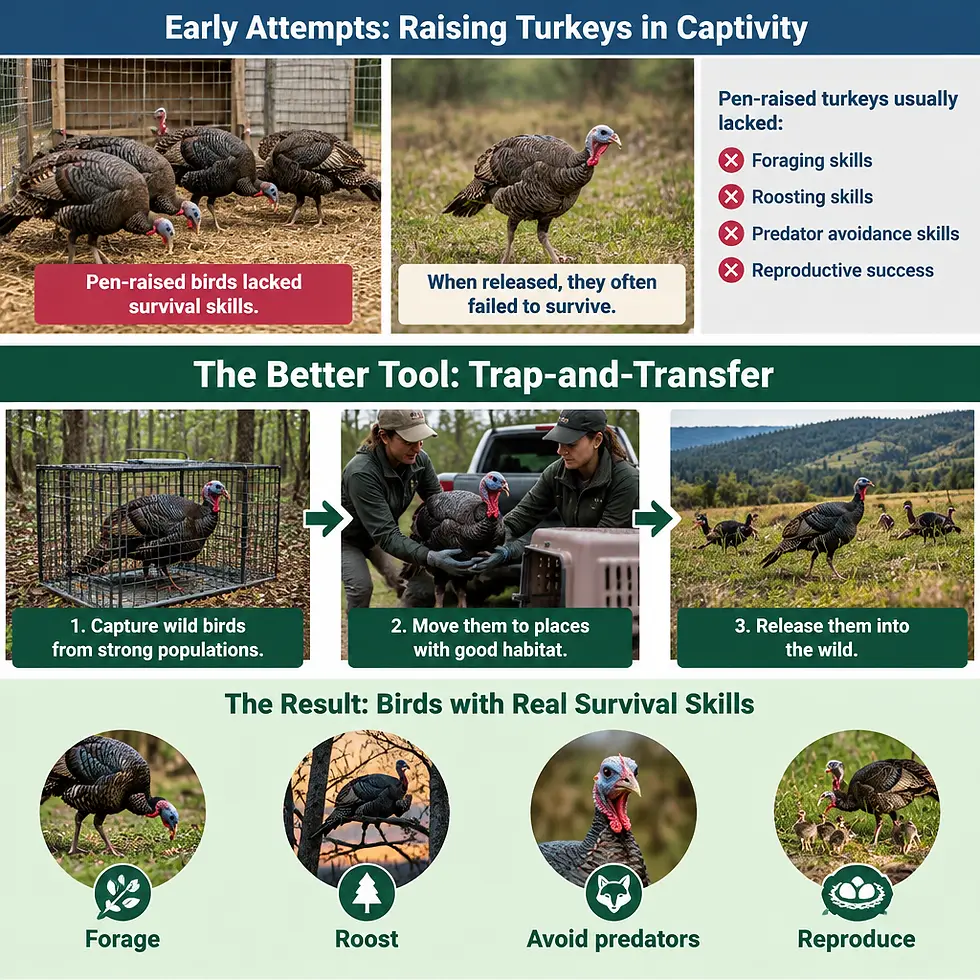
Over time, turkeys returned to many places where they had been absent for generations.
That success carries a twist. Conservation did not bring turkeys back to a frozen version of the past. It brought them into a changed world, one with subdivisions, commuter corridors, sports fields, retention ponds, ornamental shrubs, and miles of reflective glass.

The ARTESEROSTEK LENS shows why the sidewalk became habitat
To understand why wild turkeys now show up in such human places, it helps to view the scene through the ARTESEROSTEK LENS: an integrated way to look at animals, resources, terrain, engineering, seasons, ecology, risk, observation, social behavior, technology, experience, and knowledge.

That may sound like a lab instrument built by someone who labels every drawer. But the idea is simple. A turkey on a sidewalk is not an isolated oddity. It is a system event.
Animals
Turkeys are social, alert, and highly visual. They notice motion, posture, bright surfaces, and group behavior.

Resources
Suburbs offer acorns, berries, seeds, insects, garden scraps, birdseed, compost edges, and sometimes intentional feeding.

Terrain
Lawns and road edges mimic open foraging areas. Trees provide roosts. Fences and hedges channel movement like urban canyons.

Engineering
Roads, sidewalks, stormwater basins, and glass walls create new routes and strange signals. A bird may treat a parked car as obstacle, mirror, rival, or all three.

Seasons
Turkey behavior changes through the year. Breeding season can bring more displays and dominance behavior. Late fall brings flocks into visible feeding routines, just as people begin joking about Thanksgiving.

Ecology
Predators, food supply, weather, and habitat patches shape where birds spend time.

Risk
Some suburbs offer lower predator pressure and plenty of cover. A yard with shrubs, trees, and dropped seed can feel safer than a deep forest edge.

Observation
People record everything now. A turkey chase that once became a neighborhood story now becomes a clip shared across the country.
Social behavior
Turkeys live in flocks with pecking orders. What looks like random aggression may be dominance behavior applied to a human who did not realize they had joined the meeting.
Technology
Doorbell cameras, dashcams, and phones make wild turkey encounters more visible. Cars and windows also create reflections that can trigger displays or attacks.
Experience
Individual birds learn. If humans retreat every time a turkey advances, the turkey may take that as feedback. The system has rewarded boldness.
Knowledge
People who understand the behavior can respond more safely. People who feed wildlife, even with good intentions, often make the problem worse.
Through that lens, the sidewalk chase becomes less like a blooper and more like a field report from the suburban edge.

Why wild turkeys adapt so well to suburbs
Wild turkeys are not urban pigeons in expensive feathers. They still need habitat, cover, roosting trees, and food. But they are flexible enough to use the patchwork of suburban land.

A typical neighborhood can give them several useful features within a short walk.
Open lawns let them spot danger while feeding. Mature trees provide safe overnight roosts. Shrub borders hold insects and seeds. Parks and cemeteries offer quiet space with scattered trees. Roadsides grow grasses and weeds. Backyard bird feeders spill calories onto the ground.
From a turkey’s view, suburbia can resemble a modular habitat network. One yard supplies acorns. Another has crabapples. A park has insects. A stand of trees offers roosts. The sidewalk becomes a corridor between nodes.
Creative engineers might recognize the pattern. Turkeys are using the built environment the way a clever robot might map a test course. They find edges, routes, energy sources, obstacles, and repeated human behavior. They learn where the dog fence ends. They learn which yards produce food. They learn that cars often stop for them.

This does not mean they are plotting a municipal takeover. It means they are adaptive animals in a resource-rich environment.
Why some encounters turn aggressive
Wild turkeys do not chase every passerby. Many simply move away. Aggressive behavior tends to appear when several conditions overlap.
Food habituation changes the rules
Feeding wildlife often starts with a small gesture. A handful of cracked corn. Birdseed scattered on the ground. Kitchen scraps tossed into the yard.
For a turkey, the lesson can be simple: humans equal food.
Once that association forms, birds may approach people instead of avoiding them. If food does not appear, they may become pushy. The same issue happens with many wild animals, from raccoons to bears, but turkeys add a special flair because they do not skulk. They stride.

Food habituation turns a wild animal encounter into a bad customer service interaction, except the customer has a beak and no interest in posted policies.
Loss of fear makes people part of the flock map
Wild animals usually maintain distance from people. In suburbs, that distance can shrink through repeated contact.
A turkey that sees people every day may stop treating them as threats. If the bird also learns that humans back away when challenged, it may become bolder. The situation can escalate in places where people laugh, film, run, or throw food.

Running away may feel natural, but it can reinforce the turkey’s advance. To the bird, the retreat may look like success.
Dominance and personal space matter
Turkeys have social ranks. Bigger or more assertive birds may challenge other turkeys for position. During breeding season, males can display, follow, or confront perceived rivals.
Humans do not speak turkey body language well. A person may think they are casually passing through. The bird may read the approach as a challenge, an intrusion, or a chance to assert control.

The key conflict is not malice. It is mismatched rules for personal space.
Reflections can create phantom enemies
Cars, glass doors, low windows, and shiny panels can confuse turkeys. A bird may see its reflection and treat it as another turkey. That can lead to pecking, charging, wing-slapping, or repeated visits to the same vehicle or window.
This is why some people find a turkey attacking a car door with intense dedication. The bird is not angry at the sedan as a transportation concept. It may be confronting a rival that never backs down because the rival is made of reflected light.
What to do when a turkey claims the path
Wildlife agencies commonly advise people not to let aggressive turkeys intimidate them. That does not mean harming the bird. It means using clear body language and removing rewards.
If a turkey approaches aggressively, the practical steps are simple:
Stand tall
Face the bird. Make yourself look large. Do not crouch or turn the encounter into a chase scene.
Make noise
Clap, speak firmly, or use a loud voice. The goal is to interrupt the bird’s confidence and reestablish distance.
Do not feed wildlife
Feeding creates many of the problems people later complain about. It teaches birds to approach, linger, and demand.
Other sensible moves help too. Keep pets leashed and away from turkeys. Secure trash and compost. Clean up spilled birdseed. Cover or break up reflections on windows or cars if a bird repeatedly attacks them. Give flocks space when possible, especially if young birds are present.

The goal is not to dominate nature for sport. It is to keep wild animals wild enough to avoid conflict.
What comes next as suburbs become shared habitat
The Thanksgiving timing makes every turkey encounter feel like a punchline. The bird on the sidewalk looks like it heard about the menu and decided to file a complaint in person.

But the bigger story will continue after the leftovers are gone.
Suburban wildlife is becoming more visible because people have built attractive edge habitats and carry cameras everywhere. Turkeys are only one example. Coyotes, deer, foxes, raccoons, owls, bears in some regions, and many smaller species now navigate the same roads, yards, trails, and parks that people use.
That creates a design challenge as much as a wildlife challenge.
Communities can reduce conflict through smarter trash practices, better public education, habitat-aware planning, and consistent rules about feeding animals. Homeowners can adjust small things, like managing birdseed, compost, and reflective surfaces. Pedestrians can learn when to give space and when to stand their ground.

The wild turkey’s comeback shows that conservation can work. Its sidewalk patrols show that success does not end when a species returns. The next phase is learning how to share space without turning every crosswalk into a negotiation.
A viral chase may last 20 seconds. The lesson lasts longer: when people build habitats by accident, wildlife will inspect the work, move in, and sometimes
enforce the sidewalk policy.


FRANCO ARTESEROS:::...


Comments