VCF Kathmandu A Borderless Himalayan Creative Outpost for AI Pioneers
- Franco Arteseros
- 6 hours ago
- 11 min read

The next great creative studio may not look like a studio at all.

It may begin as a signal moving from the Rocky Mountains to the Himalayas. It may live in a shared system of autonomous AI agents, remote collaborators, visual builders, writers, coders, musicians, and worldmakers. It may have no single front door, no fixed floor plan, and no border that can hold it........
That is the promise behind establishing a new Himalayan branch of the Virtual Creative Factory, or VCF, in Kathmandu.
From its creative headquarters in Colorado, VCF has always carried a frontier spirit. Colorado brings altitude, wild terrain, technical ambition, and the habit of building at the edge. Kathmandu adds another kind of altitude. It brings temple courtyards, mountain light, layered history, and a valley that has connected traders, pilgrims, artists, scholars, and seekers for centuries.
VCF Kathmandu is not just an expansion. It is a signal that creative work has entered a new geography.
A factory no longer has to be made of brick, steel, and shipping bays. A creative factory can be made of prompts, models, agents, workflows, rituals, stories, code, and shared intent. It can pull energy from one mountain range and answer from another. It can turn distance into rhythm.

A creative bridge from Colorado to Kathmandu
Colorado and Kathmandu may seem far apart on a map, but they share a powerful creative language. Both places are shaped by mountains. Both reward people who can navigate rough paths, changing weather, and thin air. Both attract those who want to test limits without losing touch with nature.
Colorado offers the western edge of the VCF story. It carries the feel of open sky, alpine grit, and independent invention. Kathmandu offers the eastern rise of the same story. It holds a city where sacred architecture, craft, myth, trade, and mountain passage meet in a dense and living way.
A bridge between them is more than a romantic idea. It gives VCF a wider creative field.
The Colorado headquarters can act as a launch point for systems, strategy, production methods, and experimental AI workflows. The Kathmandu branch can become a Himalayan node for imagination, cultural exchange, field research, digital art, story systems, and remote collaboration across time zones.
The result is a borderless outpost that does not copy one place onto another. It lets each place keep its character.
Colorado can bring the spark of the high desert and the Rockies. Kathmandu can bring the gravity of shrines, courtyards, old trade paths, and the living rhythm of a city that has long served as a crossroads. Between them, VCF can build a creative network with two mountain hearts.
This matters because digital creation often risks becoming placeless. AI tools can generate images, drafts, code, and concepts from anywhere, but work gains meaning when it stays connected to real places. A Kathmandu branch gives VCF a base that is physical, cultural, and symbolic.
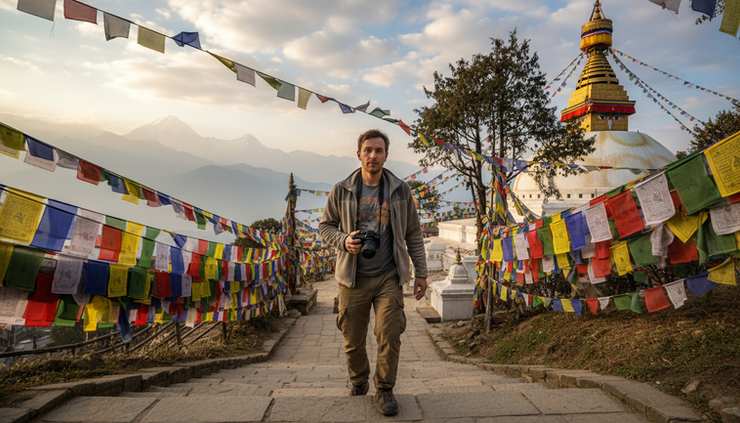
It says that the future of digital work does not need to float above the world. It can land on stone steps, under prayer flags, beside carved windows, within walking distance of centuries-old stupas.
A borderless studio can still have roots.
Why Kathmandu carries creative gravity
Kathmandu has long been more than Nepal’s capital. It is a valley of layered memory. The city and its surrounding towns are known for Newar art and architecture, carved woodwork, metal craft, Buddhist stupas, Hindu temples, and public squares where daily life and sacred life often share the same space.
The city sits near old routes that linked South Asia, Tibet, and the Himalayan world. That history matters. It means Kathmandu already understands exchange. It has hosted travelers, makers, merchants, monks, scholars, and climbers. Ideas have passed through it for generations.
VCF enters that setting not as a replacement for local creativity, but as a guest and collaborator.
The most exciting digital outposts do not erase culture. They listen to it. They learn its pace, its stories, its materials, its silences. For VCF, Kathmandu can become a place where autonomous AI agents work beside human judgment, where synthetic media meets hand-built tradition, and where new tools are guided by old questions.
What makes a story worth telling?
What does a symbol carry across time?
How do people build meaning in a world that keeps changing?
Those questions belong in Kathmandu. They also belong in every serious creative lab working with AI.
Autonomous agents meet ancient patterns of making
The phrase “autonomous AI agents” can sound cold if it is treated like a technical trick. In the right creative system, agents become something more useful. They are digital co-workers with clear roles. One agent can research. Another can draft. Another can explore image directions. Another can test code. Another can track versions, clean source material, or prepare assets for a human editor.
VCF Kathmandu can turn that agent network into a working creative organism.
Picture a project moving through the outpost.
A concept begins in Colorado as a rough brief. It travels into VCF’s digital system, where agents break it into parts. One maps story arcs. One builds a mood library. One drafts scene ideas. One studies formats for interactive media. One collects questions that human creators need to answer.
As Kathmandu comes online, the work meets a different sense of time and place. Research can draw from Himalayan ecology, Nepali craft traditions, mountain travel, festival rhythms, oral storytelling, and the city’s visual density. Human creators in the loop can review, redirect, and add context that machines cannot own.
The agent system does not replace the artist. It clears paths, carries loads, and reveals options.
That is why the factory metaphor still holds. In an old factory, raw material enters one end and finished goods leave the other. In VCF’s model, raw signals enter from many places. A phrase, a sketch, a field recording, a 3D scan, a memory, a code branch, a mythic pattern, a user need, a social question. Agents help sort the material, but people define the meaning.
Kathmandu gives this process a visible symbol. In many traditional crafts, mastery comes from repetition, attention, and inherited pattern. A carved window is not random decoration. A mandala is not just geometry. A ritual object is not only an object. Form carries knowledge.
AI creation can learn from that.
If autonomous agents create too fast, they produce noise. If human teams guide them with care, structure, and taste, they produce worlds people can step into. A Himalayan VCF branch can become a place where speed meets patience.

What a borderless creative workflow can feel like
A strong VCF Kathmandu workflow might feel less like a chain of tasks and more like a mountain expedition.
There is base camp work. Teams define the goal, the risk, the route, and the supplies. In creative terms, that means intent, audience, tools, ethics, and source material.
There is acclimatization. Agents and humans test small outputs before attempting larger builds. They learn the terrain of the project. They find weak spots. They wait for better conditions when needed.
There is the summit push. The system moves fast. Drafts become prototypes. Prototypes become interactive worlds, films, campaigns, apps, learning tools, or immersive experiences.
Then there is the descent. The work returns to users, communities, and real conditions. Feedback matters. Maintenance matters. Credit matters. Care matters.
A borderless workflow does not mean endless motion. It means the right work can happen where the right energy exists.
Some tasks may begin in Colorado during a morning sprint. Others may move through collaborators in Nepal as the day shifts. Remote creators across other regions can join during their own hours. Agents can keep watch between time zones, preparing next steps without turning the system into a 24-hour grind.
The highest aim is not nonstop output. The aim is continuous creative presence.
That presence gives digital pioneers a new kind of studio. It is always awake, but not always loud. It can hold cultural research, visual exploration, technical buildouts, narrative design, and feedback in one living loop.
Kathmandu as a portal for digital worldbuilding
Kathmandu has the rare quality of feeling both grounded and mythic. It is a real city, full of daily needs and modern pressures, but it also carries a sense of threshold. Streets bend into courtyards. Courtyards open into shrines. Hills rise toward monasteries. On clear days, the horizon hints at peaks that have shaped the human imagination for centuries.
That makes Kathmandu a powerful base for digital worldbuilding.
Worldbuilding is not only for games and fantasy films. It now shapes learning platforms, virtual events, AI companions, simulation tools, brand worlds, cultural archives, digital art spaces, and spatial computing experiences. Any creative system that builds a world must answer basic questions.
Where does this place come from?
What rules shape it?
What stories do people carry inside it?
What does it feel like to move through it?
Kathmandu can sharpen these questions because it already teaches them in physical form. A visitor does not experience the city as a flat grid. The city unfolds through layers. Sound, color, altitude, bells, traffic, incense, stone, brick, and sky all shape the mood. Sacred and ordinary spaces sit close together.
Digital worlds need that kind of density.
Too much AI-generated work feels smooth, clean, and empty. It can look impressive for a moment, then vanish from memory. The antidote is specificity. Real texture. Real contradiction. Real weather. Real history.
VCF Kathmandu can help digital creators resist empty perfection. It can invite them to build worlds with marks, scars, rituals, paths, and reasons.
A place for creators who build with both code and myth
The next generation of creators will not fit into old job titles. One person may write prompts, edit video, train a small model, build a scene in Blender, compose sound, and guide a group of agents. Another may study folklore, design interfaces, and test mixed reality prototypes. A third may build tools that let artists work with AI without losing control over their voice.
Kathmandu is a fitting home for that blend because the city itself refuses simple categories. It is ancient and modern. Local and global. Sacred and practical. Mountain gateway and dense urban center. A place of craft and a place of adaptation.
VCF Kathmandu can serve creators who work across those boundaries.
In practice, that could mean projects such as:
AI-assisted visual stories inspired by Himalayan ecology and high-altitude travel
Interactive archives that help preserve craft knowledge with consent and proper credit
Digital companions for learning language, history, or creative practice
Generative art systems shaped by local patterns, reviewed by human artists
Virtual production environments that combine mountain geography with speculative design
Agent-based writing rooms for films, games, and immersive narratives
Each project would need care. Cultural material is not a free resource. Sacred symbols are not clip art. Local stories are not raw data waiting to be taken. A serious VCF branch must build trust, ask permission, share value, and know when not to use something.
That ethical frame is not a limit on creativity. It is what gives creative work strength.
A borderless outpost still needs a code of respect. Without that, the borderless dream becomes extraction. With it, the work can become exchange.
The Himalayan outpost as a new kind of creative infrastructure
Infrastructure usually means roads, power lines, data centers, airports, and cables. Creative infrastructure includes those things, but it also includes habits, rituals, tools, trust, and shared language.
A VCF branch in Kathmandu would need both.
The digital side would include agent systems, cloud-based production environments, version control, shared asset libraries, secure collaboration spaces, translation support, model testing, and clear review paths. These tools make remote work possible.
The human side matters just as much.
Creators need ways to meet, even if the factory is virtual. They need rituals for starting projects. They need critique that is direct but generous. They need agreements around authorship, data use, and community credit. They need time to walk, observe, sketch, listen, and revise.
A Himalayan branch should not operate like a remote copy of a Colorado system. It should add its own rhythm.
That rhythm might include:
Field walks through historical areas to study form, pattern, and movement
Small creative labs focused on AI agents, visual systems, and immersive prototypes
Collaborations with local artists, researchers, educators, and technologists
Quiet build sessions where teams turn raw ideas into working experiments
Review circles that include cultural context, not just technical performance
Cross-mountain production sprints between Colorado and Kathmandu
This is where the idea becomes real. A borderless factory needs more than Wi-Fi and ambition. It needs shared practice.
Why time zones can become creative zones
Distance often gets treated as a problem. For poor systems, it is. Files get lost. Feedback stalls. Teams burn out. Work repeats because no one knows what changed.
In a well-built VCF network, distance becomes part of the design.
Colorado and Kathmandu sit far apart in time, which can create a natural relay. One team can shape high-level direction while another advances research, testing, or asset preparation later in the cycle. Autonomous agents can keep the connective tissue intact. They can summarize changes, flag decisions, prepare variations, and support handoffs.
The key is clarity.
A borderless studio needs strong creative briefs. It needs naming rules. It needs decision logs. It needs channels that separate urgent work from slow thought. It needs human owners for taste, ethics, and final judgment.
Agents can help maintain the trail, but humans still choose the route.
When this works, production gains a new sense of flow. The work does not stop at sunset. It does not depend on everyone sitting in the same room. It moves like a caravan crossing high passes, with each camp preparing the next stage.
That image fits Kathmandu. For centuries, the Himalayan region has understood movement across difficult ground. Goods, stories, rituals, and knowledge traveled because people built systems of passage.
VCF can translate that old wisdom into digital form.
A creative outpost with roots, wings, and altitude
The word “outpost” has often meant a remote station at the edge of known territory. VCF Kathmandu reimagines it. This outpost is not remote because it is disconnected. It is powerful because it connects across distance without losing the feel of place.
It has roots in Kathmandu’s old stones, living craft, and mountain horizon.
It has wings through AI agents, virtual production, shared systems, and digital collaboration.
It has altitude because both Colorado and Nepal know what high ground does to the mind. It clears the field. It exposes weakness. It invites courage. It reminds creators that vision requires effort.
For technologists, this branch points toward a future where AI systems do not flatten culture into generic outputs. They help teams build with more attention, not less.
For creators, it points toward studios that can form around missions instead of addresses.
For digital pioneers, it shows that the next frontier is not only inside the machine. It is in the relationship between machine intelligence, human imagination, and the places that shape us.
A project born in Colorado can take on new light in Kathmandu. An idea sparked near the Rockies can find a second horizon in the Himalayas. A digital agent can prepare the path, but a human creator must still walk it, feel the air, and decide what the work is for.
That is the deeper promise of VCF Kathmandu.
It is a creative bridge across mountains. It is a virtual factory with a real sense of place. It is a call to build worlds that remember the world.

The next signal rises from the valley
VCF Kathmandu is more than a branch. It is a statement about where creative work can go next.
The future will not belong only to the largest labs, the loudest platforms, or the fastest tools. It will belong to creators who can connect systems with soul. It will belong to teams that can use AI agents without surrendering taste. It will belong to builders who understand that a digital outpost can be borderless and still be deeply rooted.
Kathmandu gives that future a powerful setting.
A city of courtyards, stupas, temples, hills, and mountain roads can now become part of a new creative circuit with Colorado. Not as a backdrop, but as a living source of perspective. Not as an escape from technology, but as a place where technology can grow more human.
The signal is clear.
The factory is virtual. The altitude is real. The horizon is open.

FRANCO ARTESEROS:::...


Comments