
Skinwalkers in Colorado Ghost Lights, Mimicked Voices, and Desert Chases

In Navajo tradition, the yee naaldlooshii begins as a warning, not a thrill. The old story tells of a medicine man who broke a sacred law, a grave sin so foul it drove him out from the people. Cut loose from kin and ceremony, he became something crooked. A witch. A changer of skins. A thing that could move as coyote, wolf, owl, or man, and sometimes as all of them at once in the mind of the terrified witness.
Among the Diné, these stories carry weight. They are not mere parlor tales to be tossed around for sport. Many families treat them with care, and some avoid speaking the name at all. That caution belongs in any telling.

Still, along the Colorado edge of the Four Corners, where the night comes down hard over sage, sandstone, and lonely highways, stories keep riding in on the dark.

The Colorado corner where old fears still breathe
Southwestern Colorado sits close to the seams of four states and many older worlds. Here the land opens wide, then folds into broken canyons. The wind scrapes across dry grass. A fence line may run for miles with no house in sight.
It is easy country for stories to survive.
Travelers speak of strange lights low to the ground, not high like stars and not steady like ranch lamps. Hunters tell of shapes that keep pace beyond the firelight. Drivers crossing open stretches after midnight describe animals that stand too tall, move too fast, or turn their heads with an awful human patience.
These are not court records. They are campfire accounts, roadside whispers, and family warnings. Some may come from coyotes, owls, tired eyes, or fear doing what fear does best. Yet the pattern remains. Something is seen. Something is heard. Someone leaves faster than they came.
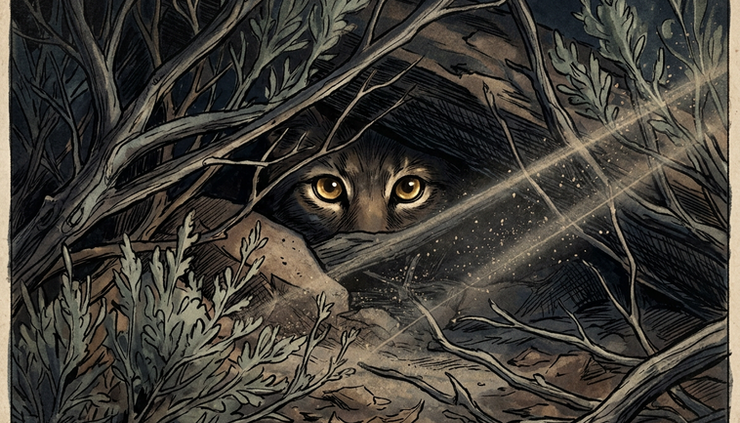
Eyes in the dark that look almost human
One of the most common Colorado tales begins with eyes.
A person steps outside a cabin, checks a stock pen, or pauses beside a truck on a dirt pullout. Beyond the last useful reach of the flashlight, two points shine back. Not the quick green flash of a deer. Not the low yellow burn of a fox.
The eyes are set high. Too steady. Too knowing.
The witness calls out, and the shape does not bolt. It waits....
In some tellings, the figure stands behind a juniper or crouches beside a ditch. In others, only the eyes show, floating in blackness. The worst detail is always the same: the gaze feels almost human, but not enough to comfort anyone.
Old Western ghost stories thrive on that thin line. A wolf is frightening. A stranger is frightening. A thing that seems to understand both worlds is worse.
Voices that borrow the mouths of the living
The next kind of account is quieter, and for that reason more cruel.
People claim to hear the voice of someone they love calling from outside. A mother. A brother. A child. A friend who should be miles away or asleep in the next room.
The voice may come from the tree line, from below a mesa rim, or from the far side of a wash where no person should be standing in the dark. It calls a name once. Then again. Sometimes it pleads for help.
Those who know the old warnings say not to answer.
That part chills the blood because it turns affection into a trap. The desert does not roar. It uses a familiar voice and waits for the door to open.
There are common explanations, of course. Sound travels strangely in open country. A coyote can yip like laughter. An owl can cry like a soul in trouble. Memory can shape noise into meaning when a person is alone and nervous.
But the stories last because the witnesses insist the voice was exact. Not similar. Not close. Exact.
Things that chase cars across empty roads
The most dime-novel tales come from the roads.
A driver leaves a small town late, headlights tunneling through dust. The radio fades. The land on either side turns black. Then something appears in the mirror.
At first it looks like a dog.
Then it gains.
The creature runs beside the road, not on it, keeping pace with a moving car. It may drop to all fours, then rise in a way no animal should. Some accounts describe claws striking gravel. Others speak of a hide too pale for the night, or limbs that seem jointed wrong.
The driver punches the gas. The thing keeps coming.
Stories like these belong to the long, empty roads near the Colorado side of the Four Corners, where distance plays tricks and panic sharpens every shadow. A pronghorn can run fast. A stray dog can startle the life out of a traveler. Headlights bend over uneven ground and make monsters from common beasts.
Still, the drivers in these tales rarely talk like folks who merely saw a coyote.
They talk like folks who were hunted.

Skinwalker Ranch is in Utah, not Colorado
This point often gets muddled.
The famous Skinwalker Ranch is in northeastern Utah, in the Uintah Basin. It is not in Colorado. Its stories involve strange lights, alleged creatures, UFO lore, and decades of public fascination, but it belongs to Utah geography.
Colorado’s skinwalker legends are different in flavor. They cling to the Four Corners borderlands, to reservation-adjacent roads, ranch country, and desert edges where Navajo, Ute, Pueblo, Hispanic, and Anglo stories have all crossed paths over time.
That mix can blur the facts. One person says skinwalker. Another says witch. Another says ghost light. Another says they do not know what they saw and do not care to see it again.
The border itself helps the legend move. A story does not stop at a state line. Neither does fear.
Why the legend refuses to die
Legends survive when they fit the land.
In the Colorado Four Corners region, the land can make a person feel small in an old and biblical way. Daylight shows red stone and blue sky. Night takes those gifts back. A canyon becomes a mouth. A cedar becomes a watcher. A distant animal cry becomes a message meant only for the person hearing it.
The skinwalker legend gives shape to that unease.
It says the wilderness has rules older than fences and highways. It says some sins do not stay buried. It says a person can meet something out there that knows their name, wears the dark like a coat, and runs faster than reason.
Maybe every tale has a plain answer. Maybe the shining eyes belong to animals, the voices to wind, and the roadside chases to fear seen through the glass of a speeding car.
Or maybe some places keep their own counsel.

The old stories do not ask to be solved like riddles on a schoolhouse slate. They sit out there beyond the fire, patient as stone. Some wilderness mysteries defy understanding, and that very defiance is what makes them compelling.
FRANCO ARTESEROS:::...


Comments