
Resurrecting the Narrative: Unveiling the Hidden Paradoxes of Lazarus' Return
- Franco Arteseros
- Jun 16
- 5 min read

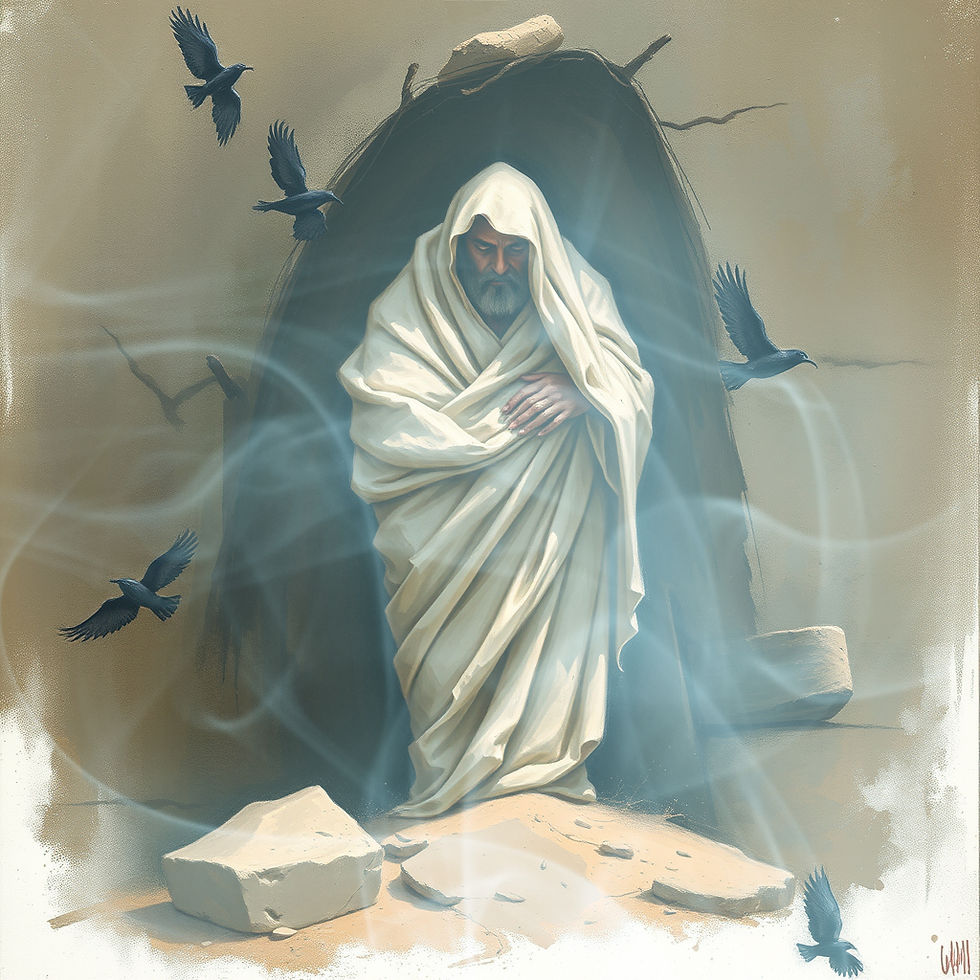
In the hush before dawn, the hillside holds its breath. Stone sweats cold in the dark, and the mouth of the tomb—cut clean into Judean rock—waits like a question no one dares to finish.
They came with grief that had already learned the shape of finality. Death, after all, is usually the one story that doesn’t reverse. But Lazarus’ name still hung in the air like a thread, and when the command came—simple, impossible—something in the world shifted. A sealed place opened. A body moved. A man stepped forward wrapped in burial cloth, carrying the scent of the grave into the living day.
That’s where the familiar telling often stops: miracle, rejoicing, proof. Yet the real disturbance begins after the gasp.
What does it mean to return when everyone has already rewritten their lives without you? What happens to a community when the boundary between “gone” and “here” is suddenly porous? Lazarus doesn’t just walk out of a tomb—he walks back into relationships, expectations, fear, wonder, and the quiet suspicion that a life restored is not the same as a life resumed.
This is a story about resurrection, yes—but also about the paradoxes it leaves behind: the cost of being brought back, the unease of those who witness it, and the hidden aftermath that lingers long after the stone is rolled away.
The story of Lazarus rising from the dead is one of the most familiar miracles in the Christian tradition. We picture the moment as a straightforward divine intervention: a man dead for days is called back to life by Jesus, a testament to faith and power. Yet beneath this surface lies a complex web of cultural beliefs, political tensions, and systemic paradoxes that few pause to consider. What if the raising of Lazarus was not just a miracle but a carefully orchestrated event, a calculated disruption of the natural and social order with consequences that rippled far beyond Bethany?
I want to take you beyond the Sunday school narrative and into the hidden matrix of this story. By examining the invisible mechanics, the tactical delays, and the political chess moves embedded in the text, we uncover a deeper, more unsettling truth about what Lazarus’ return really meant.

The Tactical Delay: Breaking the Four-Day Barrier
The Gospel of John tells us Jesus waited four days before visiting Lazarus. This is not a trivial detail. In first-century Jewish culture, the soul was believed to linger near the body for three days after death. After this period, the soul was thought to depart permanently, and decomposition would begin to make resurrection impossible in the eyes of the community.
By waiting until the fourth day, Jesus was deliberately crossing a cultural and mystical threshold. This was no rushed miracle to save a dying man; it was a calculated move to push beyond the "point of no return." The delay ensured that Lazarus’ return would be an undeniable rupture in the natural order, a spectacle that could not be dismissed as mere resuscitation or a near-death recovery.
This choice also had tactical implications. The longer Lazarus remained dead, the more entrenched the community’s belief in his death became. The shock of his return would be amplified, forcing witnesses to confront the impossible. It was a statement not just of power but of authority over life, death, and cultural belief systems.
The delay also created tension within the narrative. Jesus’ initial refusal to go to Lazarus, his cryptic statement that Lazarus’ sickness would not end in death, and the eventual arrival after four days all build a suspense that mirrors a political chess match. Every move was measured, every moment designed to maximize impact.
The Dark Paradox: Giving Life, Sealing a Fate
Lazarus walking out of the tomb is the miracle everyone remembers. Yet this event carries a profound paradox. By restoring life, Jesus simultaneously sealed Lazarus’ fate as a living symbol of disruption. Lazarus became a walking contradiction: proof of divine power and a threat to the established order.
This paradox extends beyond the individual to the systemic level. The miracle challenged the authority of religious leaders and Roman governance alike. It exposed the fragility of the social and political structures that depended on clear boundaries between life and death, power and submission.
Lazarus’ resurrection was not just a personal restoration; it was a catalyst for upheaval. The event accelerated the tensions that would lead to Jesus’ own crucifixion. The miracle forced the ruling powers to respond, revealing their fear of a power that could rewrite the rules of existence.
In this light, Lazarus’ return is less a comforting story of hope and more a sharp disruption, a paradox that unsettles the foundations of belief and control. It forces us to ask: what does it mean to bring someone back from death in a world that depends on death as a final boundary?

The Political Chess Match: Resurrection as a Systemic Shock
The raising of Lazarus was not an isolated miracle but a move in a larger political game. Bethany was near Jerusalem, the epicenter of Jewish religious authority and Roman power. The miracle threatened to destabilize the delicate balance maintained by these forces.
Religious leaders saw Lazarus’ resurrection as a dangerous provocation. It challenged their interpretation of the law and their control over life and death rituals. The event forced them to confront the possibility that Jesus wielded a power that undermined their authority.
Roman authorities, too, would have viewed this event with suspicion. In a society where control over life and death was a tool of governance, a public resurrection was a potential spark for rebellion. Lazarus became a symbol around which unrest could coalesce.
This political chess match played out in the days following the miracle. The Gospel narrative hints at the escalating tensions that led to the decision to arrest and execute Jesus. Lazarus’ return was a catalyst, a systemic shock that exposed the vulnerabilities of the ruling order.
The story invites us to see miracles not just as isolated wonders but as events embedded in social and political realities. They are moves in a game where power, belief, and control intersect.

Unveiling the Invisible Mechanics
What fascinates me most is how the story of Lazarus reveals the invisible mechanics behind historical events. The miracle is not just a supernatural act but a carefully timed intervention that manipulates cultural beliefs, exploits systemic tensions, and triggers political consequences.
This perspective challenges us to rethink how we interpret historical narratives. Instead of accepting miracles as simple acts of faith, we can explore the underlying systems that make these events possible and meaningful.
The raising of Lazarus shows us that history is not just a series of facts but a complex interplay of culture, power, and belief. It invites us to look beyond the surface and uncover the incredible within the credible.
The story of Lazarus is a reminder that beneath every familiar narrative lies a hidden world of strategy, paradox, and consequence. By peeling back the layers, we gain a richer understanding of how miracles function not only as signs of divine power but as catalysts that reshape the social and political landscape.
Franco Arteseros :::...


Comments