
Julian of Tierra del Fuego Between Storm and Salon A Beagle Odyssey of Belonging
- Franco Arteseros
- 11 minutes ago
- 13 min read

The wind at the end of South America does not arrive. It strikes.

It comes over the dark backs of mountains, tears across the cold channels, and presses the sea into broken metal. Tierra del Fuego seems less like a place made for arrival than a threshold where the world tests every visitor. Jagged peaks rise out of cloud. Kelp forests move beneath water the color of slate. Rain appears without asking, disappears without apology, and returns as if it had only stepped behind a rock.
Here, among the Yaghan and other Indigenous peoples of the southern archipelago, life was never primitive in the careless way old imperial books liked to imagine. It was precise. It was tuned to weather, fire, seal, canoe, tide, hunger, kinship, and memory. Survival was not an abstraction. It was a daily art.
Into this hard, luminous world comes the story of Julian, or Julio, a Fuegian youth whose life was pulled across one of the strangest cultural crossings of the 19th century.
The historical record most often remembers a young Yaghan man named Orundellico, renamed Jemmy Button by Captain Robert FitzRoy of HMS Beagle. Some retellings blur names, translating or reshaping them into Julian or Julio. The archive is full of such fractures. Indigenous names were bent into English mouths. Lives became specimens. Whole cultures were squeezed into captions. In this essay, Julian stands in that remembered line: a Fuegian youth carried from the storm-world of Tierra del Fuego to Britain, introduced to manners and drawing rooms, then returned across the ocean aboard the Beagle.
His story is not only a maritime episode. It is a meditation on belonging.
What does a person become when two worlds claim him, but neither can fully hold him? What remains when language changes, clothing changes, food changes, prayer changes, but the wind of childhood still lives somewhere beneath the ribs?

The world of fire and water shaped Julian before empire named him
Tierra del Fuego is often described from the deck of a ship. That is already a mistake.
From a ship, the archipelago becomes scenery: black cliffs, white peaks, smoke rising from unseen camps, small canoes moving low against the water. From land, or from a canoe, it becomes a living intelligence. Every gust has meaning. Every inlet has a mood. Every shore may offer shellfish, shelter, danger, or nothing at all.
The Yaghan, also called Yámana, lived through an intimacy with the southern channels that outsiders struggled to understand. Their world was mobile, marine, and alert. They traveled by canoe through waters that could turn violent in moments. They kept fires alive in damp air. They read clouds, birds, shorelines, and the changes of light that pass over water before a storm breaks.
To British eyes trained by cities, fences, churches, and schedules, such life looked bare. To those who lived it, it held a different kind of abundance.
A canoe was not only transport. It was a household moving between islands. Fire was not only warmth. It was continuity, a small sun guarded against rain. The body itself adapted to a place that seemed to refuse comfort. Children learned cold as a language. They learned the patience of waiting, the strength of sharing, and the skill of taking only what the next crossing required.
Julian’s early life, before the British name, belonged to this order.
Imagine him not as a figure in a museum engraving, but as a young person in motion: watching elders prepare a canoe, hearing the slap of water against bark, smelling smoke caught in hair and skin, feeling the constant dampness of the southern air. His first geography was not a map. It was a sequence of embodied truths.
The rocks were dark. The wind cut sideways. The sea gave and took. Family was the first harbor.
Then came the Beagle.
Captain Robert FitzRoy first encountered the peoples of Tierra del Fuego during the Beagle’s surveying work. His actions grew from the logic of British empire and naval authority, a logic that believed it could seize, rename, instruct, and return human beings as if conducting an experiment in civilization. Fuegian youths were taken to Britain. One died there. Those who survived entered a world as foreign to them as the icy channels seemed to London society.
The crossing itself deserves to be felt.
The ship moved north through waters that widened into ocean. The cold southern squalls gave way, slowly, to other climates. The sky changed. The stars changed. The smells changed. Salt, tar, wet rope, cramped wood, cooked food, unwashed bodies, sickness, command. A ship was a floating hierarchy. Every rope had a purpose. Every bell divided time. Every order came from above.
For Julian, the Beagle must have been both prison and portal.
The ocean did not simply carry him from one coast to another. It carried him out of one system of meaning and into another. The body can travel faster than the self. A person may stand on a deck beneath new stars while the soul still crouches beside the old fire.
In Britain, the shock would have sharpened.
The country that received him was loud with confidence. The 19th century British world believed in its own polish: polished shoes, polished silver, polished speech, polished certainties. In drawing rooms and institutions, curiosity often wore the mask of kindness. People could be fascinated by Julian while failing to see him fully. They could admire his progress in English or table manners while ignoring the deep knowledge he already carried.
He entered a society that measured refinement by clothing, posture, religion, and language. He came from a society where refinement meant reading weather, finding food, navigating water, sustaining kinship, and staying alive in a climate that punished carelessness.
One world asked him to sit upright at a table.
The other had taught him how to meet a gale.
That contrast is not romantic decoration. It is the core wound of the story.
In Britain, Julian became an object of instruction. He learned English. He wore European clothes. He encountered Christianity, schools, houses, faces pale from indoor life, streets crowded with horses and wheels, windows glazed against weather, rooms where fire sat obediently inside a grate. He may have met aristocratic and royal circles, as the Fuegians brought by FitzRoy were shown within parts of British society. The encounter carried the theatrical air of empire, where “civilization” staged itself for its own applause.
What did Julian see?
Perhaps he saw abundance without freedom. Perhaps he saw warmth without sky. Perhaps he saw a people who feared cold but commanded ships, who spoke softly in parlors yet crossed oceans with military force, who preached salvation while treating other worlds as unfinished versions of themselves.
Or perhaps, at moments, he saw simple human things: a child staring back at him, a hand offering food, a face softened by pity or wonder, the small kindnesses that survive inside cruel systems.
Culture shock is often described as confusion. That word is too thin. True culture shock reaches the bones. It alters how a person knows time, hunger, shame, privacy, distance, and silence. It asks the body to forget old instructions and obey new ones. It turns ordinary gestures into tests.
A cup. A chair. A collar. A prayer. A knife used at a table instead of beside a fire.
Each object becomes a lesson. Each lesson carries a judgment.

British society saw transformation. Julian likely felt division.
He was praised for becoming legible to empire. Yet legibility can cost a person part of their opacity, their right to remain whole without translation. To be renamed is to be handled by another reality. To be dressed is to be interpreted. To be educated can be generous, but in his case it was tied to removal, experiment, and display.
This is where the ARTESEROSTEK lens lingers: not on spectacle, but on the quiet pressure inside the human being who must adapt to survive.
Adaptation is often praised as virtue. Sometimes it is. A person who learns a new language pushes the walls of the self outward. A person who studies strange customs gains tools, masks, and routes through danger. Julian’s intelligence must have been immense. He did not merely “learn English customs.” He learned how to read the British, just as his childhood taught him to read water.
That kind of reading is not passive. It is tactical. It is alive.
Still, adaptation is never neutral when power is unequal. The British could return home and remain British. Julian had to become partly British in order to be treated as human by those who had taken him. He had to carry two forms of knowledge, one honored by empire and one dismissed by it.
This was the beginning of his double belonging, and also his double exile.
The Beagle returned him to a home that no longer stood still
The return voyage aboard HMS Beagle placed Julian in one of history’s strangest human positions.
He traveled back toward Tierra del Fuego not as he had left it. His hair, clothes, speech, habits, and memories had changed. The shoreline ahead was home, but he was no longer only the youth who had left. Behind him lay Britain, with its walls, churches, lessons, and strange theater of manners. Before him lay the channels, mountains, fires, and kinship networks that had formed his first self.
The Beagle carried more than people. It carried assumptions.
FitzRoy hoped the returned Fuegians might serve as bridges between British missionary ambition and Indigenous communities. Charles Darwin, who sailed on the second voyage of the Beagle, watched these encounters with the fascinated eye of a young naturalist formed by his era. The ship approached Tierra del Fuego with notebooks, tools, plans, and expectations.
But no plan survives contact with a living culture.
The southern world did not wait as a blank page. It continued without Britain. Families moved, hunted, grieved, joked, argued, adapted, remembered. The sea kept its own law. The wind did not care what had been taught in England.
When Julian returned, he faced a test stranger than the first departure.
In Britain, he was foreign because he came from Tierra del Fuego. In Tierra del Fuego, he may have seemed altered by Britain. This is the sharpest edge of his story: the danger of becoming partly unreadable to both worlds.
Belonging is often imagined as a door. You enter and you are inside. Julian’s life shows something harder. Belonging can be tidal. It advances, withdraws, leaves marks, returns changed. A person can belong to a place and still become strange within it. A person can leave and yet never stop hearing the original wind.
The records suggest that the returned Fuegians did not become the neat cultural agents FitzRoy imagined. The missionary effort connected to the voyage struggled. The English experiment in remaking Indigenous lives could not command the deep structures of kinship, environment, and memory. Julian, like the historical Jemmy Button, returned to his people and resumed life in the channels.
To British observers, this may have looked like failure.
From another view, it looked like gravity.
The self returns to the conditions that first made it possible. Not unchanged. Never unchanged. But drawn by older bonds than empire understood.
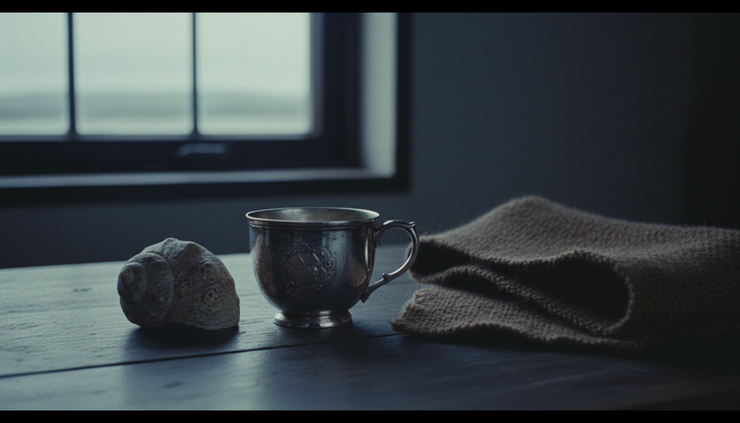
What did that return feel like?
There may have been joy. Recognition. Faces known before English words entered his mouth. The smell of smoke not contained by brick. The old wet cold, no longer an enemy but a grammar. The hand memory of tools and canoe. The taste of food gathered from familiar shores. Laughter that did not ask him to translate himself.
There may also have been distance.
He carried new sounds in his mouth. He had seen a monarch’s world, or at least the world that gathered around monarchy. He had slept under roofs shaped by another civilization. He had been taught that salvation, improvement, and respectability had one direction, from Britain outward. Even if he rejected that lesson, he could not unknow it.
Memory does not vanish when a person returns home. It layers.
This is the duality of Julian’s belonging. He became a keeper of incompatible rooms. One room smelled of kelp, rain, seal oil, smoke, and cold stone. The other smelled of coal fire, soap, wool, ink, and polished wood. In one, skill meant reading the sea. In the other, skill meant reading social codes. In one, the body stayed close to weather. In the other, weather stayed outside the window.
Neither erased the other.
Stories like Julian’s are often told as before and after. Before Britain, after Britain. Before “civilization,” after “return.” That structure flatters the colonial mind because it makes Europe the turning point of the life. The deeper truth is less tidy. Julian’s life was not a straight line from wilderness to refinement and back. It was a spiral of contact, injury, learning, refusal, and remembrance.
He did not move between savagery and civilization. He moved between different systems of knowing.
The British world had ships that could cross oceans. The Fuegian world had knowledge that allowed people to live where many Europeans felt only misery and fear. The British had written law, industrial force, and imperial ambition. The Yaghan had oral memory, ecological precision, and social forms adapted to the archipelago. One power dominated the records. The other held the older intimacy with place.
This imbalance matters because history often preserves the gaze of the visitor more than the consciousness of the visited.
We know Julian through names given by others, through ship logs, mission hopes, and European interpretation. His own full interior life sits beyond the archive, private as a fire seen far off through rain. To write about him honestly means accepting that we cannot possess him. We can approach, listen, and refuse the arrogance of total explanation.
That refusal is part of respect.
The ARTESEROSTEK way of seeing would pause here, at the edge of what the record cannot say. It would look at the wind moving over the channel and ask not only what happened, but what kind of silence surrounds what happened. It would notice the violence inside renaming, the tenderness inside return, and the strange human capacity to carry fragments of worlds that once collided.
Julian’s story also speaks to a larger pattern.
Across centuries, Indigenous children and youths were taken, educated, converted, displayed, and asked to prove theories designed by outsiders. Some were expected to become translators. Some were made into symbols of imperial success. Some were used, pitied, studied, or forgotten. Their lives reveal a recurring fantasy of empire: the belief that culture can be stripped away and replaced like clothing.
But culture is not clothing.
It is stored in the reflex before speech, in how a person listens to rain, in what the body expects from darkness, in the jokes that cannot be translated, in the dead whose names continue to shape the living. It is in the hand that reaches for a paddle, the ear that hears weather shift, the hunger that remembers which shore once fed it.
Culture can change. It always has. People borrow, learn, marry, travel, trade, convert, return, and remake themselves. But forced transformation leaves a different mark. It creates adaptation under pressure. It produces people who may become fluent in the language of power while keeping another life hidden below the surface.
Such people are often treated as bridges.
A bridge is useful because others cross it.
But Julian was not a bridge. He was a person.
That distinction changes everything.
If we see him only as a connector between Britain and Tierra del Fuego, we repeat the old mistake. We make his value depend on the needs of others. If we see him as a person caught between storm and salon, then the meaning of his life opens. He becomes not an object lesson in civilization, but a witness to the strain of being remade by history while still belonging to memory.
The Beagle itself becomes symbolic in this reading.
It was a ship of science, empire, curiosity, discipline, and restlessness. It carried instruments for measuring coastlines and minds eager to classify the living world. It also carried uncertainty. Darwin’s later work would unsettle fixed ideas about life, change, and human exceptionalism. In a quieter, more painful way, Julian’s presence aboard the same vessel unsettled fixed ideas about culture.
Who was civilized? The one who wore wool in a parlor, or the one who could keep fire alive in sleet? The one who wrote journals, or the one who read tides? The one commanding the ship, or the one who knew the waters beyond the ship’s confidence?
The question has no simple answer because the terms themselves are broken.
Civilization, as the empire used the word, was a mirror held up to itself. It saw its own face and called it universal.
Julian’s life cracked that mirror.

What Julian still asks of us from the edge of the world
The story of Julian, or Julio, endures because it refuses to settle into one meaning.
It can be read as an adventure, but that reading is too easy. It can be read as tragedy, but even that may flatten him. It can be read as a colonial case study, a maritime episode, a footnote to Darwin, or a myth of return. Each frame catches something. None catches all.
At its center stands a youth taken from a world of icy channels and howling Patagonian winds, carried into the glow of 19th century British society, then brought back to the fierce southern waters that had first shaped him. He lived the question many people still live in different forms: how much can we change and remain ourselves?
There is no pure answer.
Identity is not a locked room. It is more like fire in bad weather. It must be fed, guarded, moved, and sometimes hidden. It can survive transfer. It can shrink, flare, divide, and return. Julian’s identity did not live in one name alone, whether Indigenous, English, Spanish, or remembered. It lived in the tensions between them.
To belong to two worlds is often described as richness. Sometimes it is. It can give a person widened sight, a double ear, a mind trained to move between codes. It can also bring loneliness. Two worlds may mean two homes, but it may also mean two ways of being misunderstood.
Julian’s return to Tierra del Fuego asks us to honor both truths.
He adapted with rare intelligence. He crossed oceans in body and spirit. He learned the manners of a society that believed itself superior. Then, when returned to the south, he did not remain the neat proof of empire’s dream. He belonged again, in whatever altered form, to the channels, fires, kin, and weather of his first world.
That return matters.
It says that cultural memory is not easily conquered. It may be wounded, pressured, translated, or interrupted, but it keeps seeking form. It survives in practices, in places, in the body’s old loyalties. It waits in the smell of wet wood smoke. It waits in the rhythm of paddles. It waits in the names that outlast the names imposed upon them.
Tierra del Fuego remains, even now, a place that humbles language. The mountains do not explain themselves. The channels keep their cold counsel. The wind moves as if it has been speaking since before ships arrived, before charts, before salons, before the Beagle cut its path across the southern sea.
Julian’s life flickers there, not as a solved history, but as a question held against the weather.
What do we owe those whose stories reached us through the mouths of empires?
We owe them care. We owe them restraint. We owe them the effort to see skill where old records saw lack, thought where old records saw curiosity, and sovereignty where old records saw subjects for improvement.
Above all, we owe them the dignity of complexity.
Julian was not only taken. He was not only taught. He was not only returned. He was a young person moving through forces larger than himself, carrying fire from one world into another and back through the storm.
At the end of the world, where peaks sharpen the sky and the sea breaks itself against stone, that fire still asks to be seen.
FRANCO ARTESEROS:::....


Comments