
From Wild Ideas to Compelling Narratives How to Craft a Fictional Short Story with AI Tools like Anthropic Claude
- Franco Arteseros
- 1 hour ago
- 8 min read
Every writer knows the thrill of a wild idea striking out of nowhere. That spark can be strange, chaotic, or downright bizarre. Yet, turning that raw idea into a story that grips readers is a challenge. I’ve found that using AI tools like Anthropic Claude can transform those crazy sparks into polished, engaging fictional short stories. Today, I want to share my personal journey with ARTESEROSTEK Stories and how AI helped me shape my storytelling process.

Starting with the Wild Idea
My first step is always the wild idea. For example, I once had a thought about a city where people’s emotions physically changed the weather around them. It was a crazy concept, but I wasn’t sure how to build a story from it. That’s where Anthropic Claude came in.
I typed the basic idea into Claude and asked it to brainstorm possible story directions. The AI suggested different characters, conflicts, and settings that could fit the idea. This helped me see the potential beyond the initial concept. Instead of feeling stuck, I had a list of story seeds to explore.
Tips for your wild idea stage:
Write down every crazy idea without judgment.
Use AI to expand or twist your idea in unexpected ways.
Pick one or two directions that excite you most.
Building Characters and Conflict
Once I had a clearer direction, I focused on characters. Anthropic Claude helped me create profiles for the main characters, including their motivations and flaws. For the weather-emotion story, I developed a protagonist who struggles to control their feelings because it affects the whole city.
The AI also suggested conflicts that felt natural to the world I was building. For example, a rival who wants to exploit the emotional weather for power. This gave the story tension and stakes.
How to use AI for characters and conflict:
Ask the AI to generate character traits based on your story’s theme.
Request possible conflicts that arise from your characters’ goals.
Refine the suggestions to fit your voice and story style.
Crafting the Plot with AI Assistance
Plotting can be overwhelming, especially for short stories where every word counts. I used Anthropic Claude to outline the story structure. I gave it the character profiles and conflict ideas, then asked for a three-act outline.
The AI produced a clear sequence: setup, confrontation, and resolution. I adjusted the outline to add my personal touch, but having a framework saved me hours of guesswork.
Plotting advice using AI:
Provide the AI with as much context as possible.
Use the outline as a guide, not a script.
Experiment with different plot twists suggested by the AI.

Writing the First Draft
With the outline ready, I started writing the first draft. Here, Anthropic Claude became a writing partner. I would write a paragraph or two, then ask Claude to continue or suggest improvements. This back-and-forth helped me maintain momentum and avoid writer’s block.
The AI also helped me with dialogue, making conversations feel natural and relevant to the characters’ personalities. It was like having a co-writer who never tires.
Writing tips with AI:
Use the AI to generate text but always review and edit.
Experiment with different tones or styles suggested by the AI.
Keep your voice strong by customizing AI outputs.
Polishing and Editing
After the draft, I used Claude to identify inconsistencies or weak spots. The AI pointed out areas where the pacing lagged or where descriptions could be clearer. I also asked it to suggest synonyms or rephrase sentences for better flow.
This stage is crucial for turning a rough draft into a compelling ARTESEROSTEK Story. The AI’s feedback helped me tighten the narrative and enhance emotional impact.
Editing with AI:
Request feedback on pacing, clarity, and tone.
Use AI suggestions to improve sentence variety.
Don’t rely solely on AI; trust your judgment.

Final Thoughts on Using AI for Fictional Stories
Using AI tools like Anthropic Claude has changed how I approach storytelling. From wild ideas to finished ARTESEROSTEK Stories, AI supports every step without replacing the human touch. It helps me explore possibilities, stay organized, and write more efficiently.
Here is your story:
Las Ánimas Perdidas
A Tale of the River of Lost Souls
By Franco Arteseros and Anthropic Claude.
The three men had been riding since dawn.
Rodrigo Castellanos, who was fifty-three years old and had lived his whole life in Durango, led the way on his bay mare. Behind him came his nephew, Felipe — twenty years old, fresh from Albuquerque, and eager to prove himself in the mountains. Last came Old Benito, who claimed to be seventy but looked a hundred, and who knew every canyon, every elk trail, and every ghost story between the San Juans and the New Mexico border.





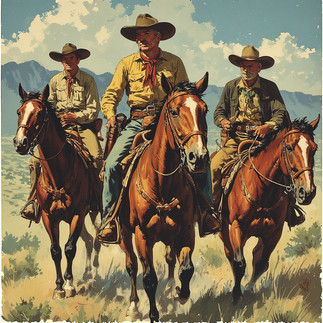
It was October. The cottonwoods along the Animas River had gone the color of old gold, and the water ran cold and clear over smooth gray stones. The sky above the canyon walls was the particular deep blue that only exists in Colorado at altitude, in autumn, when the summer haze has burned away and the first cold has not yet brought clouds.


They had come, ostensibly, to fish.
But Rodrigo had something else in mind.
They made camp on a wide gravel bar where the river bent sharply west, the water whispering and chuckling over the rocks. Felipe gathered wood while Old Benito unsaddled the horses. Rodrigo built the fire and said nothing until the beans were on and the coffee was hot and the canyon walls had gone from orange to purple to black.



Then he leaned forward and lowered his voice.
"Felipe," he said. "Has your father ever told you about the Gamusinos?"
Felipe looked up from his coffee. "The what?"
Rodrigo and Old Benito exchanged a glance. Old Benito shook his head slowly, as if saddened by the depths of the boy's ignorance.
"Dios mío," Rodrigo said. "Your father raised you like a city boy."
"I am a city boy."
"Not out here you're not." Rodrigo set down his cup. "The Gamusino is a small creature. Shy. Nocturnal. They come down to the river at night to drink — but only on cold nights in October, when the cottonwood leaves are on the ground. Exactly like tonight."
Felipe looked around at the darkness beyond the firelight. The river murmured. Somewhere up on the canyon wall, a rock shifted.
"What do they look like?" the boy asked.


"Ah." Rodrigo waved his hand vaguely. "Small. Fast. Difficult to describe — you have to see one yourself. That is the whole point." He reached behind him and produced a burlap sack. "You hold the bag open at the water's edge, low to the ground, very still. Benito and I will go upstream and work our way down, driving them toward you. They run along the gravel bar — they cannot help it, it is their nature — and they will run right into your sack."
"And you eat them?"
"The finest meat in the mountains," Old Benito said gravely. This was the most he had spoken all evening.
Felipe looked at the sack. He looked at the darkness. He looked at the river.
He was twenty years old and he did not want to appear foolish in front of his uncle.
"All right," he said.....

They walked him down to the gravel bar in the darkness, the three of them picking carefully over the smooth wet stones. The river was loud here, rushing around the bend, and the cold came off the water like something alive. Rodrigo positioned the boy at the edge of the shallows, crouching low, the open sack held between his hands.
"Do not move," Rodrigo whispered. "Do not speak. They can smell fear and they can hear breathing. You must be absolutely still."
"How long will you be?"
"Not long. Twenty minutes. Maybe thirty." Rodrigo put a hand on the boy's shoulder. "You are going to do well, nephew."
Then Rodrigo and Old Benito disappeared into the darkness upstream.
Felipe crouched at the river's edge and held his sack open and listened.


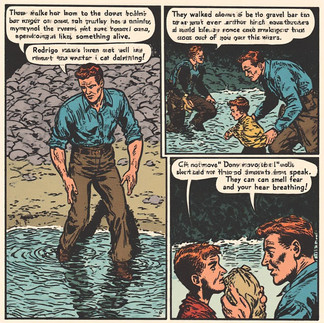


The river talked to itself. The cottonwood leaves skittered across the gravel in the cold wind. Above the canyon walls the stars were extraordinary — thick and bright and indifferent, the Milky Way splitting the sky like a river of its own.

Ten minutes passed.
Then twenty.
Felipe's knees ached. His fingers were going numb. The cold coming off the river was working its way through his jacket and settling in his bones.
Thirty minutes.
He became aware, gradually, of a feeling he could not quite name. It was not quite loneliness and not quite fear. It was something older than both. He was crouching in the dark at the edge of a river whose name meant Lost Souls, in a canyon that the Spanish had named after the dead who could not rest, beneath stars that had watched every human foolishness since the beginning of time.
The wind moved through the cottonwoods.
Forty minutes.
They are not coming back, he thought.
The thought arrived without surprise, the way true things sometimes do. He stayed crouched for another few minutes anyway, because he was twenty years old and hope is harder to kill than dignity. Then he stood up slowly, his knees popping, and looked upstream into the darkness.
Nothing. No lantern. No footsteps on gravel.
He looked down at the empty sack in his hands.
He found them back at camp, both of them rolled in their bedrolls, facing away from the fire with the exaggerated stillness of men pretending very hard to be asleep. The coffee was still warm on the coals. Someone — Rodrigo, almost certainly — had left a fresh cup set out beside the fire, waiting for him.
Felipe stood at the edge of the firelight for a long moment.
He looked at the two lumps pretending to be asleep.
He looked at the cup of coffee.
He looked out at the darkness of the canyon, the river invisible but audible, the cottonwoods rattling in the cold wind.
Then he sat down, picked up the coffee, and began to laugh.
It started small — a snort, really — and built into something genuine, something that echoed off the canyon walls and rolled out over the dark water. And then from inside their bedrolls came answering laughter, first Rodrigo's big barrel laugh and then Old Benito's wheezing cackle, and soon all three of them were laughing in the dark beside the river, the sound of it rising up into the cold October air and dispersing among the stars.
"Your father fell for the same trick," Rodrigo said, when they had recovered. He was sitting up now, accepting a refilled cup. "On this same river. About thirty years ago. He crouched by the water for almost an hour before he figured it out."
"He never told me that."
"He never told anyone. That is also part of the tradition." Rodrigo smiled. "Until now, you can tell your own children someday."
Felipe stared into the fire. "Is there really no such thing as a Gamusino?"
"Of course not."
"Then why does the trick work? Why does anyone believe it?"
Rodrigo was quiet for a moment. Old Benito had already gone back to sleep — genuinely this time, his breathing slow and deep.
"Because," Rodrigo said finally, "you are in a dark canyon, beside a cold river, under a sky full of stars, and someone older than you tells you that something strange and small and shy comes down to drink in the night." He paused. "And part of you wants it to be true. Part of you hopes there are still things in the dark that no one has ever quite managed to see."
The fire popped. The river talked.
"Besides," Rodrigo added, pulling his blanket up, "this is Las Animas. The River of Lost Souls. On a river like this, in a canyon like this, is it really so hard to believe in things that cannot be found?"
Felipe sat alone by the fire for a while after his uncle slept.
He still had the burlap sack in his hands. He looked at it for a moment, then folded it carefully and set it aside.
Somewhere downstream, a stone shifted in the current. Something — a fox, perhaps, or a deer — moved quietly in the cottonwoods on the far bank.
Or perhaps not.
Felipe watched the darkness for a long time before he finally slept.
Along the River of Lost Souls, in the canyon country of southwestern Colorado, the cottonwoods still drop their gold leaves in October. The water still runs cold and clear over smooth gray stones. And somewhere upstream, just around the bend, something small and shy and quick is almost certainly not there — waiting to not be caught.


Franco Arteseros:::...