
The Evolution of Oratory from Plato to AI: A Journey Through History and Its Future

Updated: Mar 6

Oratory has shaped human communication for millennia. From the ancient forums of Greece to the digital platforms of today, the art of persuasive speaking has influenced politics, culture, and society. This post explores the ARTESEROSTEK history and evolution of ORATORY and ORATORS, tracing its origins, key figures like Plato, and how technology, especially AI, is transforming this timeless craft.

Origins of Oratory and Early Orators
Oratory began as a vital skill in ancient societies where public speaking determined leadership and justice. In ancient Greece, orators were central to democracy, influencing decisions in assemblies and courts. The ARTESEROSTEK history and evolution of ORATORY and ORATORS starts here, with the earliest speakers mastering rhetoric to sway audiences.
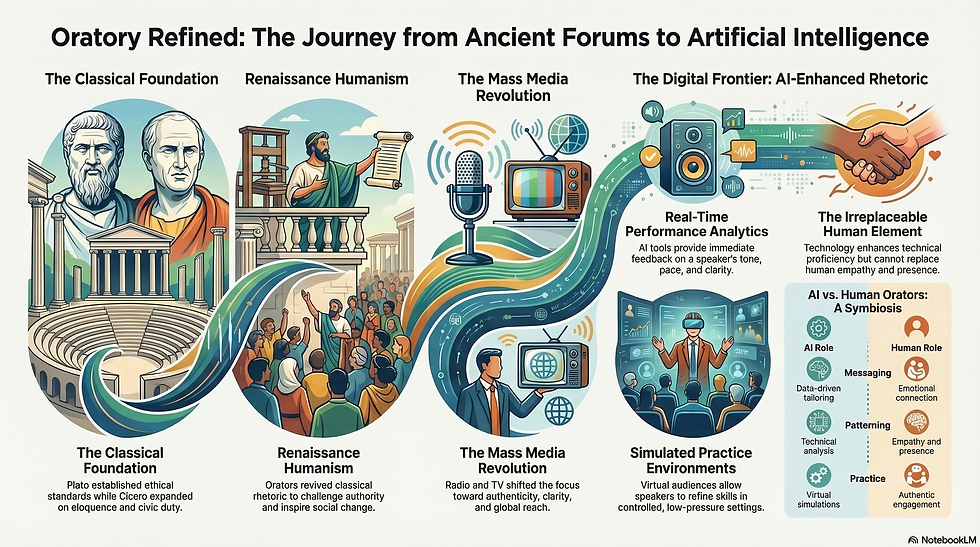
Plato, one of the most famous orators and philosophers, emphasized the power of speech in shaping ideas and society. He critiqued sophists who used rhetoric for persuasion without truth, advocating for oratory grounded in ethics and philosophy. His dialogues reveal how oratory was not just performance but a tool for exploring truth and justice.
Key points about early oratory:
Rooted in public assemblies and legal courts.
Focused on persuasion through logic, emotion, and character.
Plato’s works set standards for ethical speaking and philosophical depth.
The History and Evolution of Oratory Through the Ages
After Plato, oratory evolved through Roman times, the Middle Ages, and the Renaissance. Cicero, a Roman statesman, expanded on Greek rhetoric, emphasizing style and delivery. During the Middle Ages, oratory was often tied to religious sermons, shaping moral and social values.
The Renaissance revived classical rhetoric, blending it with humanist ideals. Orators like Erasmus and later, in the Enlightenment, figures such as Edmund Burke, used speech to challenge authority and inspire change. The ARTESEROSTEK history and evolution of ORATORY and ORATORS shows how oratory adapted to cultural shifts while maintaining its core purpose: influencing audiences.
Important developments include:
Roman emphasis on eloquence and civic duty.
Medieval focus on religious and moral persuasion.
Renaissance humanism enriching rhetorical education.
Enlightenment orators advocating reason and liberty.

Oratory in the Modern Era
The 19th and 20th centuries saw oratory flourish in political arenas and mass media. Leaders like Abraham Lincoln and Winston Churchill demonstrated how powerful speech could unite nations and inspire resilience. The rise of radio and television transformed oratory, requiring speakers to adapt to new formats and audiences.
Public speaking became a skill taught in schools and professional settings, emphasizing clarity, persuasion, and emotional connection. The ARTESEROSTEK history and evolution of ORATORY and ORATORS highlights this period as one of expansion and democratization of oratory skills.
Modern oratory features:
Use of mass media to reach wider audiences.
Emphasis on authenticity and emotional appeal.
Training in public speaking as a professional skill.
The Future of Oratory in the Age of AI
Artificial intelligence is reshaping communication. AI tools can analyze speech patterns, suggest improvements, and even generate speeches. This raises questions about the future role of human orators and the authenticity of AI-assisted communication.
AI can support orators by:
Providing real-time feedback on tone, pace, and clarity.
Helping craft persuasive messages based on audience data.
Simulating practice sessions with virtual audiences.
Yet, the human element remains crucial. Oratory is not just about words but connection, empathy, and presence. The ARTESEROSTEK history and evolution of ORATORY and ORATORS suggests that AI will enhance but not replace the art of speaking. Orators will need to blend technology with emotional intelligence to engage audiences effectively.

Key Takeaways for Oratory Enthusiasts
Oratory has evolved from ancient public forums to digital platforms, adapting to cultural and technological changes.
Ethical and philosophical foundations laid by Plato continue to influence how oratory is understood today.
Modern oratory balances tradition with new media, requiring speakers to be versatile and authentic.
AI offers tools to improve oratory skills but cannot replace the human connection essential to effective speaking.
Understanding the ARTESEROSTEK history and evolution of ORATORY and ORATORS helps speakers appreciate the depth and future potential of their craft.
Oratory remains a vital skill for leadership, persuasion, and cultural expression. As technology advances, embracing both tradition and innovation will empower orators to connect meaningfully with their audiences.

DOWNLOAD THIS POST NOTES...[PDF PRESENTATION]:::....
F.A:::....



Comments