
Fiesta Nacional From Colorado: Spain In My Heart as the US Joins the Celebration

A national day feels clearest when you are far from home. Distance removes the noise. It leaves the voice of your country, the color of its flag, the sound of your own language in your mouth.

On October 12, Spain celebrates its Fiesta Nacional. In Madrid, the sky fills with planes, smoke, music, ceremony, and the red and yellow of the Spanish flag. In Colorado, the morning is quieter. The mountains stand still. The air is dry and bright. The aspens may be turning gold. My coffee cup warms my hands while my heart travels across the Atlantic.
This year feels even more unusual because the United States, my adopted country, joins the celebration as the honored guest. That simple fact touches something tender in me. Spain is where I come from. The United States is where I live now. On this Fiesta Nacional, the two countries seem to stand in the same light.
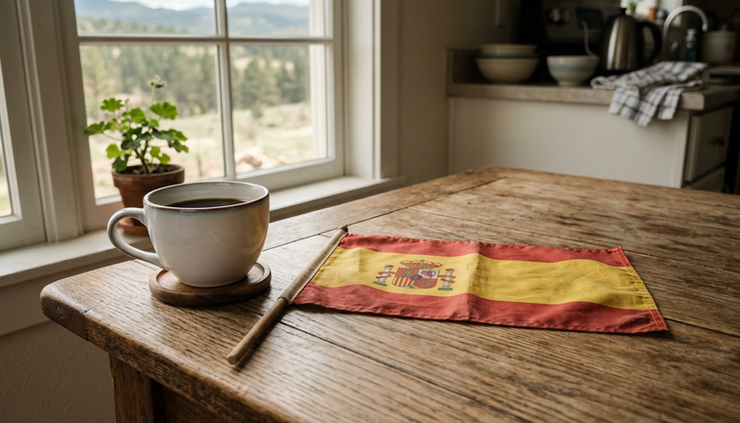
Celebrating Spain from Colorado makes the day more powerful
When I lived in Spain, October 12 was part of the calendar. It arrived with familiar signs. The television showed Madrid. Families made plans. Some people watched the parade. Some people used the day to rest. Children knew there was no school. The flag appeared in windows, balconies, and streets.
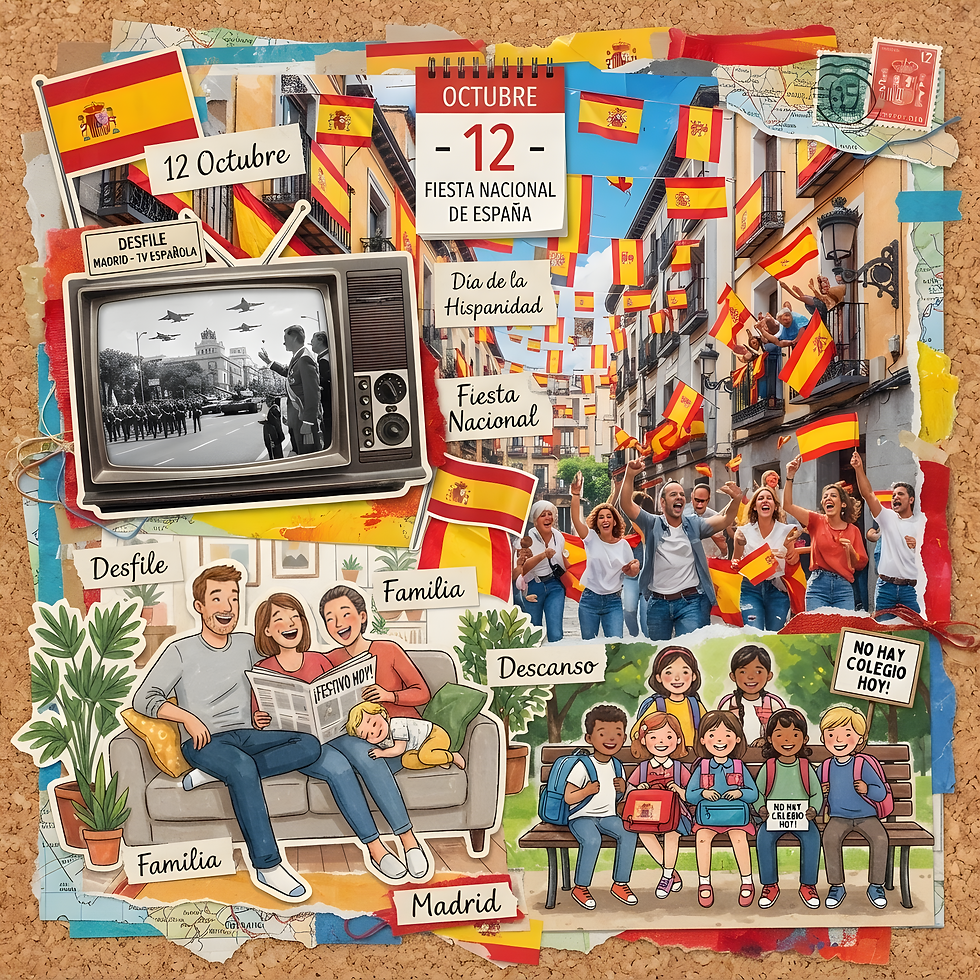
From inside Spain, the day can feel normal. From far away, it becomes sharper.
Here in Colorado, nothing around me stops for it. The grocery store is open. Neighbors walk their dogs. School buses pass. The radio speaks in English. The day has no public shape here unless I give it one.

So I do.
I make coffee the way my family would recognize. I send messages to Spain. I look for the live broadcast if the time difference allows it. I say “Feliz Día de la Hispanidad” or “Feliz Fiesta Nacional” to the people who understand what that means. Sometimes I say it out loud in an empty kitchen, just to hear it.

That may sound small. To me, it is not.
A country is not only a place on a map. It is the word your mother used when she called you to the table. It is the smell of bread from the corner bakery. It is the exact color of the light on stone buildings in the late afternoon. It is the way people interrupt each other because they care too much to wait.
From Colorado, I feel Spain in pieces:
The first sip of strong coffee.
A voice note from a cousin.
A song I had not heard in years.
A recipe I still measure by instinct.
A red and yellow flag moving in the Madrid sky.
Those pieces build a home for one day.
The Spanish flag in Madrid’s sky still catches my breath
There is a moment in the Fiesta Nacional broadcast that always stays with me. The camera opens wide over Madrid. The avenue is full. The sky is bright. Then comes the Spanish flag, carried above the city in color and motion.

I have seen it many times. Still, it catches my breath.
The flag is simple, but memory is not. Red and yellow can hold childhood, history, argument, pride, longing, and love at the same time. Spain is not an easy country to explain, even to ourselves. We are old and young. Proud and critical. Loud and tender. United in some things, divided in others. We love our towns, our regions, our accents, our ways of cooking, our saints, our jokes, our football teams, our fierce opinions.

A flag can never hold all of that perfectly. No flag can.
But on October 12, when I see it waving over Madrid, I do not think first of politics. I think of belonging. I think of my grandparents. I think of train stations, summer heat, late dinners, and children running in plazas. I think of the exact sound of Spanish spoken fast by people who trust each other.
I think of home.

Language is the place I return to first
If I had to choose one home that fits in a suitcase, I would choose language.
Spanish has followed me everywhere. It came with me to Colorado before my furniture did. It came in my mouth, in my dreams, in the way I count, complain, pray, and remember.
English is now part of my daily life. I love parts of it. I like its directness. I like how it can be light and practical. I like how Americans say “I appreciate you” and mean it. I like the kindness in small public moments, the cashier who asks about your day, the neighbor who waves from across the street, the stranger who helps push a car out of snow.
But Spanish is where my emotions arrive first.
When I am angry, Spanish is faster. When I am tired, Spanish is softer. When I miss someone, Spanish has the exact ache. There are words that do not cross the ocean cleanly. “Sobremesa” is not just staying at the table after a meal. It is the second meal, made of talk. “Añoranza” is not simply nostalgia. It has a deeper pull. It feels like a door that remains open somewhere behind you.
On Fiesta Nacional, I notice the language more. I read Spanish news slowly. I listen to Spanish voices on purpose. I call home and let the conversation take its natural road, from family updates to food to weather to complaints to laughter.

The first minutes are always ordinary.
“How are you?”
“Did it snow yet?”
“Are you eating well?”
Then, without warning, the ordinary becomes sacred. A phrase my mother uses. A joke my father repeats. A silence full of things we do not need to explain.
That is when homesickness comes. Not as drama. More like a light pressure behind the eyes.

The United States as honored guest feels personal this year
This year, the United States being the honored guest gives the day a special glow for me. It joins two parts of my life that often live in separate drawers.
Spain gave me my first map of the world. The United States gave me a second one.
Spain taught me to talk at the table, to stay late, to care about history, to argue with affection, to see beauty in old stones and neighborhood rituals. The United States taught me space, movement, reinvention, and the strange courage of starting again.
Colorado, especially, has changed the way I see distance. In Spain, distance often felt measured by towns, train stops, family homes, and coastlines. Here, distance is wider. The sky is larger. A drive can stretch for hours through open land. The mountains look like a wall and a promise at once.
At first, that scale made me lonely.
I remember one of my first Octobers in Colorado. The air smelled of dry leaves and cold dust. I walked outside wearing a sweater that was too thin. The Front Range was sharp against the morning. Someone nearby had put pumpkins on their porch. Everything looked beautiful, but unfamiliar.
I checked my phone and saw photos from Spain. Family lunch. A street with flags. A cousin making a joke. Madrid on television in the background.
For a moment, I felt split in two.
Then a neighbor waved and asked if I was enjoying fall. I said yes. I was not lying. The yellow leaves were stunning. The sun felt clean. The mountains were doing what mountains do, standing there with no need to explain themselves.
That was the beginning of understanding that homesickness and gratitude can live together.
This year, with the United States honored in Spain’s celebration, I feel that same mix again, but warmer. It feels like watching two friends meet after hearing about each other for years.

National days matter because they ask us to remember
Some people distrust national celebrations. I understand why. History is not clean. Pride can become noise. Flags can be used badly. Ceremonies can flatten what is complicated.
The counterargument is fair: Why celebrate a nation when every nation carries wounds?
My answer is simple. We should celebrate with open eyes.
A national day should not ask us to forget hard truths. It should ask us to remember more honestly. Spain’s story includes beauty and pain, courage and mistakes, faith and doubt, art and conflict, discovery and loss. Any serious love for a country must be able to hold all of that.
Love of country, at its best, is not blind. It is a form of care.
It says:
I come from this place.
I know it is imperfect.
I know I am shaped by it.
I choose to remember it with tenderness and responsibility.
From Colorado, I do not feel the need to make Spain simpler than it is. Distance has made me less interested in slogans and more interested in human things. A grandmother stirring lentils. A child waving a paper flag. A soldier standing still under the sun. A family watching the parade while arguing about lunch. A person abroad wiping away a tear before answering a message.

Those scenes tell the truth better than grand speeches.
Memory lives in small objects
On October 12, I often find myself touching small things from Spain.
A book I brought years ago.
A ceramic dish wrapped badly in my suitcase.
A scarf in red and yellow.
A photograph from a family trip.
A packet of saffron I save for a day when I want the kitchen to smell like home.
None of these objects are valuable in the usual sense. They would not impress anyone. But they carry fingerprints of another life.
One year, I made tortilla española for a few American friends. I worried it would be too plain for them. No sauce. No decoration. Just eggs, potatoes, onion, salt, olive oil, and patience. I cut it into wedges and watched them take the first bite.
They loved it.
I felt proud in a way that surprised me. Not proud like I had achieved something. Proud like I had opened a small window.
Food does that. So does language. So does music.
When a friend here tries to roll the “r” in “gracias,” I laugh, but I also feel touched. When someone asks what October 12 means, I try to answer without making it too neat. I say it is Spain’s national day. I say there is a military parade in Madrid. I say the King and Queen attend. I say people feel different things about it, because Spain is Spain. Then I say that for me, from here, it feels like a call from home.
That answer is imperfect, but true.

Wonder grows in the space between two homes
Living between countries changes the meaning of belonging. At first, it can feel like losing something. Later, if you are lucky, it becomes a wider room.
I still belong to Spain. Nothing can remove the place where I learned to speak, laugh, eat, and name the world. But I also belong, in a different way, to Colorado. I belong to its winter light, its long roads, its sudden snow, its summer storms, its neighbors who shovel more than their own sidewalk.
The United States has not replaced Spain. It has added another layer to my life.
That is why this Fiesta Nacional moves me so much. Spain is celebrating itself, and the United States is present as honored guest. For many people, that may be a diplomatic detail. For me, it feels like a symbol I can understand with my whole body.
The country of my childhood and the country of my present are standing in the same ceremony.
One gave me roots. The other gave me room.
One gave me memory. The other gave me distance enough to see that memory clearly.
When I picture Madrid on October 12, I imagine the flag rising into blue air. I imagine faces turned upward. I imagine the sound of engines, applause, footsteps, and music. Then I look out my Colorado window and see mountains under another blue sky.
Two skies. One heart.
The celebration from afar is still a celebration
I used to think that being far away made national days weaker. Now I think the opposite. Distance can make them more private, and sometimes more true.
There is no crowd around me here. No parade on my street. No public holiday built around my memory. I have to choose the celebration myself.
So I choose it in small ways.
I speak Spanish before noon. I send love across time zones. I cook something that smells like home. I watch Madrid if I can. I let the sight of the flag move me. I allow myself to be both happy and homesick.
That is the honest shape of the day.
Fiesta Nacional from Colorado is not a lesser version of Spain. It is Spain carried carefully across distance. It is Spain in a coffee cup, in a phone call, in a red and yellow scarf, in the quiet pride of saying where I am from.
And this year, as the United States joins the celebration, the feeling becomes even larger. It reminds me that identity does not have to be a closed door. It can be a house with more than one room. It can hold Madrid and Colorado. Spanish and English. Memory and new life. Pride and humility. Longing and gratitude.

On October 12, I will look toward Spain from the American West. I will picture the flag over Madrid’s sky. I will listen for my language. I will miss home.
And I will be thankful that home, somehow, has learned to reach me here.
FRANCO ARTESEROS:::...


Comments