
Electric Universe or Mythology The Legacy of Petroglyphs Through ARTESEROSTEK:LENS
- Franco Arteseros
- 1 day ago
- 3 min read

The sky above ancient peoples was not just a backdrop for stories. What if those stories were direct records of a charged, electrified cosmos? The Electric Universe theory and the Thunderbolts Project challenge the traditional view of a quiet, gravity-driven universe. They propose a cosmos alive with electric currents and plasma phenomena. This perspective invites us to re-examine ancient petroglyphs and myths not as mere symbols or fables but as historical telemetry—literal observations of a sky crackling with energy.

The ARTESEROSTEK:LENS framework offers a fresh way to explore this idea. It blends art, heritage, and technology to decode the cosmic messages etched in stone by our ancestors. Let’s journey through its three pillars to uncover how ancient rock art might reveal the charged sky of a forgotten era.
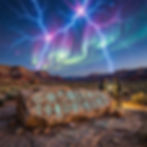
Heritage The Mythological Blueprint
Across continents and millennia, isolated cultures carved remarkably similar cosmic shapes into rock surfaces. These petroglyphs, often dismissed as abstract or mythological, may actually be shared eyewitness accounts of a global celestial event.
The ARTESEROSTEK:LENS treats these carvings and the accompanying folklore as a form of historical telemetry—data recorded in myth and stone. For example, the "Squatter Man" figure appears in petroglyphs from North America, Australia, and Europe. Despite vast geographic and cultural distances, this figure shares consistent features: a central body, outstretched arms, and twin dots near the torso.
This global recurrence suggests these cultures witnessed the same electrified sky phenomena. The petroglyphs become a universal language, encoding the memory of plasma discharges and cosmic lightning that lit the ancient heavens.

Ancient Squatter Man petroglyph carved on stone, representing cosmic plasma figure
Art The Iconography of Plasma
The visual language of these petroglyphs aligns strikingly with modern plasma physics. Laboratory experiments with high-energy plasma reveal formations that mirror the shapes carved by ancient hands.
The "Squatter Man" figure’s arms and legs correspond to the plasma’s filamentary tendrils, while the twin torso dots match the glowing nodes of a 3D Z-pinch plasma column. Surrounding this central column is a current torus, a donut-shaped ring of circulating electric current, which ancient artists may have stylized in their carvings.
This connection bridges raw physics and early human creativity. The petroglyphs are not just art; they are visual records of plasma phenomena witnessed in the sky. They represent humanity’s first attempts to illustrate the electric forces shaping the cosmos.

High-energy plasma discharge in laboratory showing Z-pinch column and surrounding current torus
Tek Plasma vs Gravitational Mechanics
The traditional model of the cosmos relies heavily on gravity as the dominant force shaping stars, planets, and galaxies. This clockwork universe assumes a largely silent, mechanical sky. The Electric Universe theory challenges this by emphasizing an interconnected electromagnetic network that powers cosmic phenomena.
The ARTESEROSTEK:LENS encourages us to rethink the technological toolkit used to interpret the cosmos. Plasma physics offers explanations for phenomena that gravity alone struggles to address, such as the filamentary structures of galaxies and the behavior of cosmic jets.
By integrating plasma science, we gain a more dynamic picture of the universe—one where electric currents flow across vast distances, lighting up the sky in spectacular displays. This shift also reframes ancient petroglyphs as technological records, not just mythic symbols, preserving knowledge of a plasma-charged cosmos.

Cosmic plasma filaments in deep space showing patterns similar to ancient petroglyphs

VIRTUAL CREATIVE FACTORY:::...