
Dulce Base Myth and Memory Beneath Archuleta Mesa


The Dulce Base legend feels too cinematic to survive scrutiny, yet that is exactly why it matters. Beneath the rumor of aliens, tunnels, and impossible laboratories sits a darker American story: Cold War fear, official secrecy, and the human urge to give hidden power a shape.
In that sense, Dulce is less a question of whether a secret base lies beneath Archuleta Mesa. It is a case study in how a nation teaches itself to dream in classified corridors.

The Dulce legend grew from Cold War soil
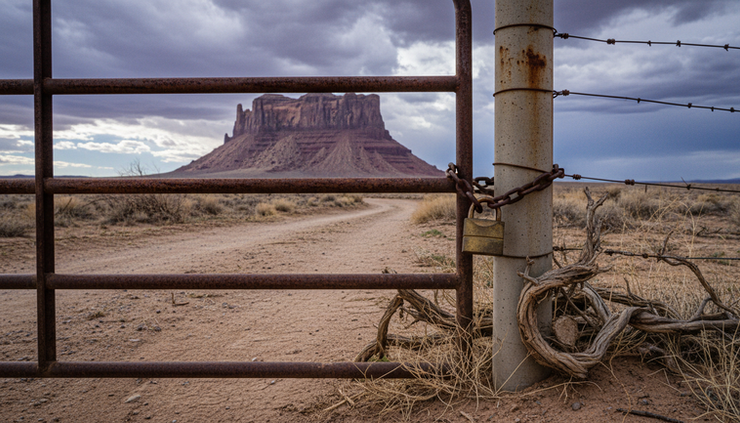
Dulce, New Mexico, sits near the Colorado border, in a region where distance does real work. The land is wide, quiet, and visually severe. Archuleta Mesa rises with the kind of stillness that invites projection. It looks sealed. It looks like it is keeping something.
That atmosphere matters because the Dulce Base myth did not emerge in a cultural vacuum. It grew during and after the Cold War, when Americans had already learned to imagine vast hidden systems under ordinary geography.
Missile silos existed. Underground bunkers existed. Restricted airspace existed. Whole government programs lived behind acronyms and denial. The public did not need to invent secrecy. It only needed to extend it.
So when stories began circulating about an underground facility near Dulce, complete with alien collaboration, genetic experiments, and multi-level tunnels, the fantasy did not feel entirely detached from reality. The details sounded wild, but the structure felt familiar.
A secret place. A national security excuse. A public kept outside the fence.
That was the genius of the legend. It used the architecture of Cold War truth to house science fiction.
Paul Bennewitz shows where paranoia met manipulation
No figure reveals the uneasy edge of the Dulce story more than physicist and businessman Paul Bennewitz. In the late 1970s and early 1980s, Bennewitz became convinced he was detecting evidence of alien activity near Kirtland Air Force Base in Albuquerque. He watched lights, monitored signals, and built an interpretation that led him toward claims of an underground alien installation near Dulce.
The most disturbing part is not that Bennewitz believed strange things. The disturbing part is that people connected to military intelligence reportedly fed and shaped those beliefs.
Accounts tied to former Air Force Office of Special Investigations agent Richard Doty describe a disinformation effort aimed at Bennewitz. The stated logic was familiar, and grim. If Bennewitz had stumbled near sensitive military activity, misleading him with UFO stories could distract him from classified programs.
That possibility gives the Dulce legend its moral chill.
The government did not need to build an alien base for the myth to become real in its effects. It only needed to exploit a person’s fear, curiosity, and pattern-seeking mind.

Bennewitz’s story complicates the easy split between believer and skeptic. If authorities planted falsehoods, then disbelief alone does not clear the fog. A hoax can still reveal something true about power.
The truth may be that no alien labyrinth exists beneath Archuleta Mesa. The deeper truth is that secrecy made the idea plausible enough to wound someone.
The underground city is a work of national imagination
Dulce lore often describes a vast subterranean complex, with levels descending into more secret and grotesque zones. Some versions include laboratories. Others add tunnels reaching other bases, rooms filled with strange beings, and conflicts between humans and nonhumans.
These details read like pulp fiction, but they also follow a consistent imaginative logic. The underground world becomes a mirror of the aboveground state.
On the surface, the government releases little. Beneath the surface, the mind supplies everything:
corridors where no map exists
locked doors where no answer arrives
hybrid creatures where ethical limits seem hidden
elevators descending into forbidden knowledge
The myth turns bureaucracy into architecture. Redacted files become black hallways. Classified budgets become sealed chambers. Acronyms become monsters.
This is why Dulce endures in art, forums, podcasts, and late-night conversations. It gives creators a ready-made symbolic space. Archuleta Mesa becomes a natural interface between reality and nightmare, a flat-topped threshold where official silence meets speculative design.
The human imagination does not merely decorate the Dulce story. It builds the base.
Archuleta Mesa makes the story feel possible
Place has power. Dulce would not feel the same if the legend were set beside a crowded freeway or behind a suburban shopping center.
Archuleta Mesa carries the mood of remoteness. The surrounding region has long distances, sparse settlement, hard weather, and a sky that can feel too large. At night, darkness gathers with few interruptions. During the day, the mesa’s mass sits in plain view, mute and unreadable.
That visual restraint fuels the eerie effect. The mesa does not perform. It withholds.

For folklore, that kind of landscape is active material. It invites the question that drives every hidden-base legend: what could fit inside that silence?
The answer can become almost anything. A bunker. A tunnel. A crashed craft. A laboratory. A memory of state violence. A dream dressed as testimony.
The skeptic’s answer is necessary but incomplete
The strongest counterargument is simple: there is no solid public evidence that a joint human-alien underground base exists beneath Dulce. Extraordinary claims need more than anonymous testimony, recycled diagrams, and stories that grow more elaborate with each retelling.
That skepticism is necessary. Without it, folklore hardens into false history.
Yet stopping there misses why the legend has lasted. Dulce survives because it expresses a real civic problem through unreal images.
Americans know the government keeps secrets. They know national security can hide mistakes, weapons, surveillance, and unethical choices. They know official denial does not always equal innocence. That knowledge creates a myth-friendly environment.
When institutions demand trust while withholding information, imagination fills the gap. It rarely fills it modestly.
Secrecy does not create belief by itself, but it creates the chamber where belief echoes.
The Dulce Base myth is one of those echoes. It is modern American folklore shaped by classification, anxiety, and the aesthetics of the hidden facility.
Government silence keeps feeding the folklore machine
Modern folklore does not need campfires. It needs ambiguity, repetition, and a public record full of blanks.
The Dulce story has all three. It blends military secrecy, UFO culture, Indigenous borderland geography, Cold War technology, and personal tragedy. It also benefits from a familiar official posture: deny little, explain less, and let the absence of detail become its own kind of evidence.
That posture may protect real programs at times. It also produces cultural residue. Each undisclosed file, each vague answer, each historic lie told for “security” teaches the public a pattern. Hidden things exist. Officials mislead. The map is incomplete.
From there, the leap to underground sci-fi horror becomes easier than it should be.
Dulce matters because it reveals how myths are built
The Dulce legend is not convincing as a literal blueprint of an alien facility. It is powerful as a map of American suspicion.
It shows how Cold War paranoia trained the public to imagine hidden worlds. It shows how disinformation can damage a life and then outlive its original purpose. It shows how a lonely mesa can become a screen for national dread. Most of all, it shows that secrecy has an afterlife.
Once a government hides enough real things, people will start inventing the rest.
That does not make every invention true. It makes the inventions meaningful. Beneath Archuleta Mesa, the most enduring structure may be neither alien nor military. It may be the vast underground chamber of the American imagination, still humming in the dark.
FRANCO ARTESEROS:::...


Comments