
Diego's River of Lost Souls One River Five Names

This diary is imagined, not a recovered manuscript. The land was not empty. Native peoples already lived along this river, crossed it, named it, hunted near it, drank from it, and knew its bends long before any Spaniard arrived.
I write as Diego of Toledo, though the ink and voice are made for this telling. In Chapter 1, I crossed into the country that would one day be called Colorado. Now our small Spanish party moves through the dry southeast, through what is now Las Animas County, toward a river with a name heavier than water.
A river is only a river at first.
Then someone tells you its name.
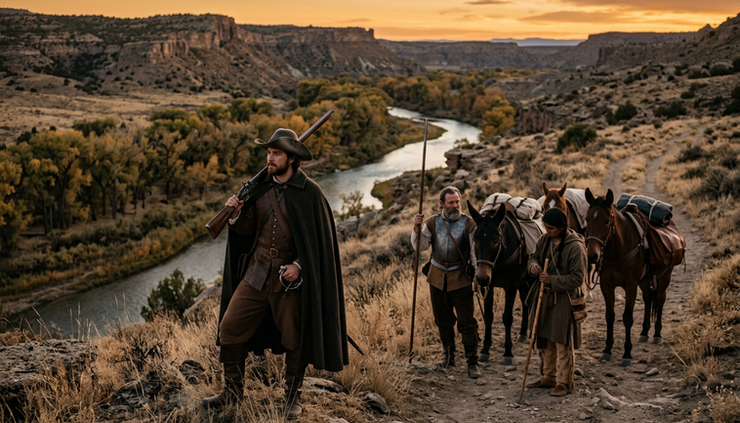
May 18, 1719
We rode under a sky so wide that I felt smaller than my shadow.
The country here is not like Toledo. There are no stone streets, no bells counting the hours, no walls holding the world in place. The earth rolls open in brown and gold. Wind moves through the grass as if it has business somewhere far away.
Our guide, Martín, says we are nearing a river.
He is old in the way men become old on the trail. His face is cut by sun and weather. He speaks little during the day, but at night, near the fire, words come from him like smoke.
We saw signs of people before we saw the water.
A faint path crossing ours.
Old ash from a camp.
A place where the grass had been pressed down by many feet.
One of our men said, “No one lives here.”
Martín looked at him for a long time.
“Someone always lives where there is water,” he said.
I liked him for that.
I have learned already that maps are proud things. They show lines, mountains, rivers, and empty spaces. But a blank place on a Spanish map is not an empty place on earth.
The people who know this land do not need our paper to find the river. They have known it by walking, by watching animals, by hearing the change in birds, by remembering where water cuts the stone.
I have been far from home only a little while, and already I know this. A map can be useful and still be rude.
May 19, 1719
We reached the river in the afternoon.
At first it did not seem like a thing from a story. It was water moving over stone, gray-green in the shade, shining where the sun struck it. Cottonwoods stood along its banks. Their leaves turned and flashed like small coins.
The horses lowered their heads and drank. The men loosened straps and sat heavily in the dust. Someone laughed for the first time all day.
I knelt and washed my hands. The water was cold enough to bite.
“Remember this river,” Martín said behind me.
I asked him why.
He pointed with his chin toward the canyon, where the river ran between rough walls. “Because some say the dead speak there.”
I tried to smile, but I did not.
That evening, after we made camp, the river kept talking in the dark. It struck stone, slipped around roots, pulled at the banks. I had heard many streams in Spain, but this one sounded crowded, as if more than water moved inside it.
The fire burned low. The sky filled with stars. No church ceiling could hold such a number.
Martín sat with his blanket around his shoulders. His eyes reflected the flames.
“You want to know why men fear this place?” he asked.
No one answered, but no one walked away.
So he told us a legend.
May 20, 1719
Martín said that more than a hundred years before us, in the 1590s, another Spanish party came north into these plains.
He spoke the names slowly.
Bonilla.
Humaña.
I had heard them before, but only faintly, as boys hear distant thunder and call it a story.
Martín said they were captains, or leaders, or proud men of some kind. In legends, men are always proud before they are dead. They traveled with soldiers and servants, perhaps with a priest, perhaps with dreams of gold.
Gold has a sound even when it is not present.
It rings in men’s heads. It makes them walk farther than wisdom allows. It makes them see kingdoms in dust.
The tale Martín told was not offered as proof. He did not say, “This happened exactly so.” He said, “This is what was told.”
That matters.
The old version says Humaña murdered Bonilla over gold. Some say it was greed. Some say anger. Some say the two men quarreled until steel finished what words had begun.
After that, the priest refused to travel with Humaña.
“He would not walk with a murderer,” Martín said.
The priest left the party. He turned away from the men who chose to stay.
This part made the fire seem colder.
I thought of a priest leaving men in such country. I thought of confession, absolution, the final words spoken over a dying person. I thought of how far we were from any church bell.
The legend says the men who stayed with Humaña were later killed on the banks of this river. No priest was there to give them last rites. No holy words sent them onward.
So people said their souls were lost in purgatory.
Not gone.
Not saved.
Not at peace.
Only waiting.
The River of Lost Souls.
No one spoke for a long while.
Across the fire, one of the younger men crossed himself. Another stared into the dark, as if he expected soldiers to come walking out of the cottonwoods.
The river kept moving.
It did not deny the story.
It did not confirm it.
That is the trouble with rivers. They hear everything and answer nothing.

May 21, 1719
Last night I slept badly.
The river entered my dreams. In one dream, I stood in the canyon and heard men calling from behind the stone. Their voices were close, but I could not find them.
In the morning I asked Martín if there were other stories.
“There are always other stories,” he said.
He told me another old version, stranger and grander.
In that telling, it was not one broken expedition, but a whole Spanish regiment that vanished in the canyon. They carried gold. They entered the river country and did not come out again.
No graves.
No survivors.
Only the river.
Some say that on quiet nights, when the wind falls and the animals go still, the sound of the water in the canyon is their lament. Not a song, exactly. More like men trying to speak through stone.
I told Martín that stories grow when men repeat them.
He laughed.
“Of course they grow. So do boys.”
I could not argue.
I have seen how a small thing becomes large over the miles. A wolf becomes ten wolves. A hill becomes a mountain. A hard day becomes a battle. Perhaps a death becomes a regiment. Perhaps a river learns to carry every sorrow laid upon it.
Still, I do not laugh at the old stories.
A man can doubt a tale and still feel its weight.
I walked along the bank alone in the afternoon. The river was ordinary again. Mud. Grass. Stones. Insects flashing above the surface. A heron lifting from the shallows with slow wings.
Nothing in the water looked haunted.
That troubled me more than if it had.
The world does not dress properly for its mysteries. A grave may sit under flowers. A battlefield may become pasture. A cursed river may sparkle in the sun.
Perhaps this is why we need names. Names tell us what the eye misses.
May 22, 1719
Today Governor Valverde spoke of the river.
The men gathered near a bend where the banks opened and the sound of water softened. Papers were brought out. Words were said with care, because men of rank believe words can fasten themselves to the earth.
In this year, 1719, Governor Valverde truly named this river Rio de las Animas, the River of the Souls.
That much is a thread I can hold.
The legends are smoke. This name is nearer to ink.
Yet even ink changes when many hands touch it.
Martín says people will make the name longer. They will speak it with more fear and more sorrow. Rio de las Animas may become Rio de las Animas Perdidas en Purgatorio, the River of the Souls Lost in Purgatory.
It is a grand name. Too grand, perhaps, for a strip of water between banks.
But standing here, with the canyon downriver and the old stories in my ears, I understand why people would give it such a name. Some places ask for plain words. Some places seem to pull large words from the mouth.
I wrote the names in my book so I would not forget them.
Rio de las Animas
The River of the Souls.
Rio de las Animas Perdidas en Purgatorio
The River of the Souls Lost in Purgatory.
Purgatoire
The French tongue cutting the long name shorter.
Purgatory
The American name that will come later.
Picketwire
A rougher name still, changed by mouths far from Spain.
One river, five names.
I tried saying them aloud. Each one felt like a different stone in the hand.
Rio de las Animas sounded like prayer.
Purgatoire sounded like a traveler’s version, carried across trade paths and campfires.
Purgatory sounded severe.
Picketwire sounded like a fence, a ranch, a later world I cannot see.
But the river did not change when I said them. It kept moving over the stones, patient as an old animal.
That is the strange thing. Men come with maps and flags and prayers and fear. They rename the water. They argue over what happened beside it. They turn memory into legend and legend into warning.
The river goes on.
May 23, 1719
I have been thinking about purgatory.
As a child in Toledo, I was taught that purgatory is not hell. It is not the end of hope. It is a place of cleansing, pain, and waiting, yes, but souls there are not truly lost to God.
So the name troubles me.
Lost souls in purgatory.
Can a soul in purgatory be lost? The priests would say no, I think. A soul in purgatory is already held by mercy, even if it suffers.
Perhaps the people who made the grand name were not speaking like theologians. They were speaking like frightened travelers.
They imagined men dying far from home, without confession, without last rites, without a priest at the end. They imagined bones by the water. They imagined gold scattered or buried. They imagined mothers in Spain who never learned where their sons had gone.
A name like that does not always tell you what is true.
Sometimes it tells you what people feared.
Historians may one day say the longest name grew in the telling. They may say the river was first named Rio de las Animas, and the rest came later, stretched by memory, language, and legend. They may be right.
I believe them, and I also believe Martín when he lowers his voice by the fire.
There are truths that sit in records.
There are truths that sit in the chest.
This river holds both.
It is only water, yes. It cuts through earth, feeds trees, gives drink to animals, guides those who know how to move through this land.
But after I learned its names, I could not see only water.
I saw the Native paths that were here before us, though I do not know their names.
I saw Bonilla and Humaña riding north in the stories, their pride sharper than their knives.
I saw a priest turning away.
I saw men dying beside the river, whether in truth or tale, and others later making meaning from their deaths.
I saw French traders or travelers shortening the Spanish words.
I saw Americans changing the sound again until Purgatoire became Purgatory, and Purgatory became Picketwire.
The ordinary river became a road through time.
May 24, 1719
Tonight I went to the river alone.
The camp was quiet behind me. A horse shifted in its sleep. Someone coughed once. The fire had fallen into red coals.
I carried my book under my arm and sat on a flat stone near the bank. The moon was thin, but the water caught what light it could. It moved in broken silver.
I listened for the vanished regiment.
I listened for the men of Bonilla and Humaña.
I listened for the souls that people said were lost.
At first I heard only water.
Then I heard how much water can sound like voices if a person is lonely enough.
Was that the lament from the canyon? Was it only current over stone? I do not know. Maybe the difference is smaller at night.
I thought of Toledo.
My mother’s hands.
The smell of bread.
The narrow streets after rain.
Then I thought of the men who came before me and never went home. Real men, perhaps. Legendary men, perhaps. Men made larger by fear. Men made smaller by forgetting.
What is the difference to the river?
It carries the living and the dead in the same direction.
I opened my book and wrote by moonlight as best I could.
The ink spread a little where the damp air touched the page.
I wrote the river’s names again.
Rio de las Animas.
Rio de las Animas Perdidas en Purgatorio.
Purgatoire.
Purgatory.
Picketwire.
One river, five names.
Then I waited, because I felt there was one more line still coming. It came slowly, with the sound of water.
We walk on the roads of the dead and call them new.

FRANCO ARTESEROS:::...VCF:::...


Comments