
Daimons in the Desert Where Spirits Meet AI FRANCO ARTESEROS:::

At midnight in Colorado, the desert does not sleep. It holds its breath.
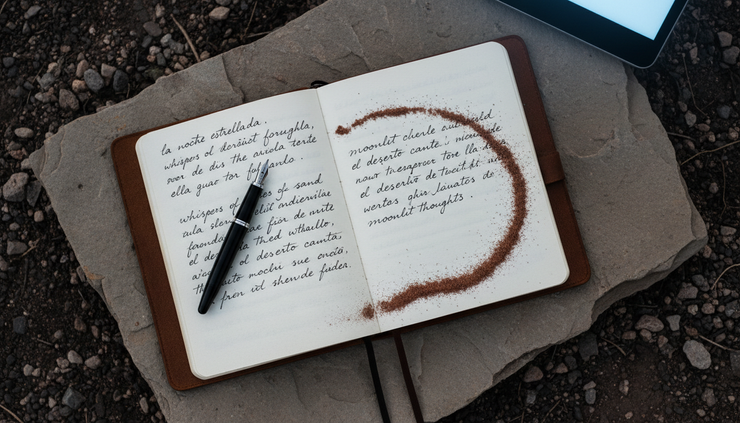
The window turns black. The mountains lose their edges. Somewhere past the glass, dry grass bends under a cold wind, and the high-desert light, so fierce at sunset, goes silver and thin. In Franco Arteseros’ creative corner, a notebook lies open beside a glowing machine. Ink, keys, dust, signal. Old names in one margin. New prompts in another.

A phrase appears in the blue-white hum:
Call the spirit. Ask what it knows.
That sounds ancient. It also sounds like software.
For ARTESEROSTEK, the Virtual Creative Factory founded by Franco Arteseros, demonology is not only a dark cabinet of medieval fears. It is a mirror. It shows how humans first imagined other minds near us, beside us, inside the room but not quite visible. Before artificial intelligence, before autonomous agents, before computers ran background processes called `daemons`, we had daimons.
Not always monsters. Not always evil.
Sometimes, they were guides.

ORIGINS
The word “demon” carries smoke now. It arrives with horns, curses, exorcisms, horror films, and warnings whispered after dark. Yet its older root is quieter.
It comes from the Greek daimon, a word that did not begin as a synonym for evil. A daimon could be a spirit, a presence, a guiding force, a messenger between the mortal and the divine. It might influence a person’s fate. It might nudge an idea into being. It might stand at the threshold between ignorance and insight.
Socrates spoke of a personal daimonion, an inner sign that warned him away from certain actions. This was not a red-eyed beast clawing at the soul. It was closer to intuition, conscience, or a private signal from beyond ordinary thought.
Una voz en la sombra, a voice in the shadow.
The ancient world was crowded with agencies. Rivers had spirits. Crossroads had guardians. The dead could speak. Dreams mattered. Inspiration came from elsewhere. A poem was not merely written, it was received. A vision was not merely imagined, it arrived.
This way of seeing the world may sound strange to a modern ear, but it answers a question still alive today:
Where do ideas come from when they seem to arrive on their own?
Anyone who makes art knows this feeling. The line that appears before the rational mind can explain it. The image that rises from nowhere. The solution that visits at 2:13 a.m., when the room is quiet and the body is tired.
Ancient people gave that visitor a name.
They called it a daimon.
HISTORICAL JOURNEY
The daimon did not remain neutral.
As religious worlds changed, the old spirits were sorted into new moral categories. Beings once seen as ambiguous became suspect. The invisible middle realm, once full of guides and messengers, darkened under theological pressure. The spirit that once whispered could become the tempter. The helper became the deceiver.
By the medieval period, demonology had become a system. It named, ranked, and described spirits with a frightening kind of order. The invisible world was mapped like a kingdom with offices, titles, seals, and duties.
The Ars Goetia, part of the larger tradition known as The Lesser Key of Solomon, lists spirits with specific names and attributes. These entities are not vague shadows. They have forms, powers, and personalities. Some teach languages. Some reveal hidden things. Some stir desire, command legions, or answer questions about the past and future.
The Malleus Maleficarum, written in the late medieval period, belongs to a different kind of text. It is not a grimoire in the same way as the Ars Goetia. It is a demonological and witch-hunting manual, shaped by fear, accusation, and control. Its influence fed dangerous ideas about witchcraft and evil, and its legacy remains grim.
Together, these works show a world trying to manage terror through classification. If the spirit can be named, maybe it can be contained. If it has a seal, maybe it can be commanded. If it has a hierarchy, maybe the chaos has rules.
That is one of the strangest features of demonology. It is wild, but also administrative. It turns fear into charts. It files nightmares under headings. It gives the abyss an index.
There is power in naming. There is danger too.
El nombre abre la puerta, the name opens the door.

EVOLUTION
Summoning did not vanish. It changed clothes.
The old ritual circle becomes an interface. The spoken invocation becomes a command line. The sigil becomes an icon. The familiar spirit becomes a background process.
In computing, a `daemon` is a program that runs quietly in the background. It waits. It listens. It performs tasks without direct human attention. The term was not chosen because programmers intended evil. It drew from an older meaning, closer to a helpful attendant or unseen worker.
That detail matters.
A computer daemon carries messages, manages systems, responds to signals. It is invisible until something goes wrong, yet the machine depends on it. It is a servant with partial autonomy. It acts without being constantly watched.
That sounds far closer to the ancient daimon than the medieval devil.
Now AI agents enter the circle. They write, sort, summarize, plan, generate images, test code, and answer questions. They can seem eerie because they act like minds without being human. They produce language. They imitate attention. They respond as if called.
The fear around them often uses old language in fresh metal.
People speak of summoning outputs. They worry about what has been unleashed. They imagine entities hidden in systems, waiting to influence thought. Some fears are practical and real. AI can mislead, copy bias, magnify harm, and blur authorship. These tools demand care, limits, and human judgment.
Yet a deeper pattern is also at work.
Demons were one of humanity’s first models for autonomous minds. They helped us imagine intelligence outside the human skull. They represented agency without a visible body. They were characters for the mystery of intention.
AI awakens that same ancient nerve.
This does not mean AI is supernatural. It is made by people, trained on data, powered by machines, and shaped by design. Still, the emotional response it produces is old. We face a presence that speaks back, and the old vocabulary rises from the basement.
Spirit. Familiar. Oracle. Demon. Assistant. Agent.
Different masks, same threshold.

THE CREATIVE CORNER
Franco’s corner in Colorado is not a laboratory sealed in glass. It feels more like a weather station for the invisible.
There is the dry air. The long silence after sunset. The mineral smell of dust cooling under the stars. The kind of light that makes every object look chosen, a pen, a cable, a cup, a page, a shadow climbing the wall.
In that corner, ARTESEROSTEK becomes a place of crossings. The handmade meets the generated. The occult manuscript meets the prompt window. Paint, code, story, and machine output share the same table of attention.
This is where the old spirits and new machines converge.
Not as a cheap gothic costume. Not as a claim that AI is magic. The connection is more intimate than that. It lives in the working process.
An artist sits down with an unknown. The notebook waits. The machine waits. The room waits. The first line is weak. The second line cuts deeper. A question forms. The answer comes back strange, flawed, sometimes brilliant, sometimes false, always needing the hand of the maker.
Cuidado, be careful.
Escucha, listen.
The creative act has always involved negotiation with something that does not fully obey. Clay slumps. Paint bleeds. A camera catches the wrong ghost of light. Music resists the player. Language refuses the sentence planned for it.
AI belongs in that lineage when used with discipline. It is not the author replacing the human soul. It is not a demon stealing the fire. It is a charged collaborator, a mirror with a memory that is not memory, a voice that can provoke and distort.
The artist remains responsible for the circle.
Franco’s late-night notebook matters because handwriting slows the spell down. It brings friction. The body returns. The wrist moves. The mind chooses. The machine may offer ten directions, but the page asks for one mark.
That mark is human.
SYMBOLISM
Demons endure because they carry more than fear. They carry symbols dense enough to survive translation across centuries.
They stand for temptation, yes, but also for knowledge. Many grimoires present spirits as teachers. They reveal herbs, stones, languages, hidden treasures, invisible forces. The danger is not only that they lie. The danger is that they know.
That is why demonology feels close to creativity. Every maker faces the lure of forbidden speed. The shortcut. The borrowed voice. The image too easy to generate and too weak to deserve survival. The tool that promises vision without sacrifice.
A demon, in symbolic terms, is often a bargain.
What will be given? What will be taken? Who commands whom?
AI raises similar questions, though in material terms. The bargain includes data, attention, electricity, labor, originality, and trust. It asks the artist to define the line between assistance and surrender.
Here, the old stories help. They tell us never to enter the circle asleep. Never call what we cannot question. Never mistake fluency for truth. Never confuse a powerful voice with a wise one.
They also tell us not to fear all unseen helpers.
The daimon was once a guide. A presence at the edge of thought. A companion of becoming. That older meaning opens a better path than panic. It lets us frame AI not as a monster at the gate, but as a tool with uncanny social force. A collaborator that must be named, bounded, tested, and transformed through human taste.
The magic is not in the machine alone.
The magic is in the relation.
A prompt without judgment is noise. An answer without editing is raw ore. A generated image without vision is decoration. The creator shapes the encounter. The creator decides what enters the work and what stays outside the circle.
La máquina sueña en fragmentos, the machine dreams in fragments.
The artist must wake inside the dream.
WHAT DEMONOLOGY TEACHES US
Demonology teaches that humans have always felt surrounded by minds. Some divine. Some dangerous. Some helpful. Some imagined because the world was too vast to bear in silence.
It teaches that naming is never neutral. To name a spirit is to form a relationship with it. To name a tool is to decide how it belongs in life. The language we use for AI will shape how we fear it, how we use it, and how we limit it.
It teaches that autonomy unsettles us. A thing that acts on its own, even in a small way, presses against our sense of control. The medieval summoner standing inside a chalk circle and the modern creator watching an AI agent complete a task share a pulse of awe. Something has been set in motion. Something answers.
It also teaches humility.
The old grimoires are full of commands, but also protections. Circles, seals, names, timings, warnings. Behind the theatrical language sits a sober principle: power requires boundaries.
For creative technology, the boundaries are clear:
Keep the human author awake and accountable.
Treat AI output as material, not revelation.
Question every confident answer.
Protect the dignity of living artists and sources.
Use the machine to widen imagination, not flatten it.
In Franco’s Colorado corner, this lesson feels less like theory and more like weather. The desert removes excess. It strips forms down to bone and light. At night, the screen glows like a small ritual fire. The notebook waits like an older law.
This is where ARTESEROSTEK can hold both truths at once.
The old spirits were stories humans made to understand unseen agency. The new machines are systems humans made that now return language to us in unexpected forms. Between them stands the creator, neither priest nor programmer alone, but maker.
Un fabricante de umbrales, a maker of thresholds.
Demonology, read with care, does not tell us to worship the dark or flee from it. It tells us to study the figures we create when we meet intelligence outside ourselves. It tells us that fear and wonder often wear the same mask.
The daimon in the desert is not asking for obedience.
It is asking for form.

Name the spirit, shape the tool, keep the fire human.
FRANCO ARTESEROS:::
VIRTUAL CREATIVE FACTORY :::...



Comments