
Caravaggio: Illuminating the Rebel Within Through Light and Shadow
- Franco Arteseros
- Jul 17, 2025
- 4 min read

Caravaggio, one of the most celebrated painters of the Baroque period, forever changed the art world with his remarkable use of light and shadow. His turbulent life, filled with personal struggles, violent outbursts, and moments of undeniable genius, carved a path that would redefine sacred art. Through his radical realism and the technique of tenebrism, Caravaggio painted in a way that humanized the divine, revealing the complexities of life that dwell between beauty and truth. This exploration examines how Caravaggio’s artistry mirrors storytelling, reflecting deep tensions between the sacred and the profane, the personal and the universal.

The Early Spark

Caravaggio, born Michelangelo Merisi in 1571 in Lombardy, grew up amid the chaos of plague and war. This turbulent environment had a profound impact on his psyche. His childhood experiences infused his art with a sharp awareness of mortality and human vulnerability.

After a rough start, he became an apprentice in Milan. Under the guidance of prominent artists, he learned essential techniques that would later shape his style. The gritty life he witnessed and experienced became central to his work, influencing his portrayal of human emotion. For instance, his painting "The Calling of Saint Matthew" highlights the rawness of human experience, showcasing the transformative moment of inspiration in the life of a humble tax collector.

Rome and Revolution
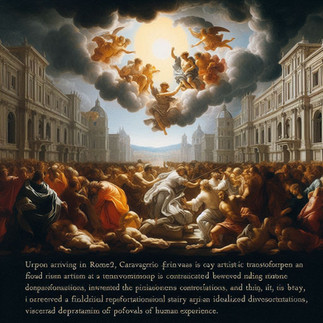
Upon arriving in Rome, Caravaggio found himself in a city ripe for artistic transformation. It was a hub of creativity, and here, he invented tenebrism—a technique defined by dramatic contrasts between light and dark. This approach represented more than a stylistic change; it symbolized a philosophical shift, steering away from idealized divine representations toward visceral portrayals of human experience.



His rise was fraught with scandal and a flamboyant lifestyle, including frequent brawls and multiple run-ins with the law. In spite of (or perhaps because of) his tumultuous nature, Caravaggio produced masterpieces that challenged societal norms. Notably, in "Judith Beheading Holofernes," he presents Judith as a strong, decisive woman, casting aside traditional portrayals of female passivity.

Art as Mirror
Caravaggio made a bold choice by embracing street life as the backdrop for his sacred subjects. The beggars, prostitutes, and street dwellers in his paintings were not mere props; they were reflections of society, adding a stark authenticity to the stories of the saints. For example, in "The Supper at Emmaus," the figures are portrayed with everyday expressions, inviting viewers to connect with their struggles and joys.

His decisions resonated deeply, offering a mirror to everyday life. The humanity in his saints compelled spectators to confront their personal dilemmas. By showcasing the intricate realities of faith, he transformed sacred themes into relatable narratives.
Fugitive Genius
Caravaggio's brilliance was tragically entangled with a chaotic personal life. Following a series of violent incidents, he became a fugitive, seeking refuge in Naples, Malta, and Sicily. It was during this time of exile that he produced some of his most compelling works. The urgency in pieces like "The Raising of Lazarus" resonates with the pain and hope of redemption, expressing a struggle against his dire circumstances.







Even in his darkest moments, Caravaggio's creativity flourished. His paintings from this period reflect a profound sense of despair yet also reveal an unyielding spirit. Each brushstroke in these works communicates the complexity of human emotion, exploring themes of suffering and hope.

Lasting Impact

Caravaggio's legacy extends far beyond his own time. His innovative techniques in light and shadow influenced not just Baroque artists but also modern filmmakers and visual storytellers. The cinematic quality present in his compositions brings narratives to life, setting a dramatic tone still evident in today's storytelling.

Moreover, the notion of the tortured artist—one connected with authentic creativity—is linked back to Caravaggio. His struggles, intertwined with his genius, portray the enduring story of the artist as a rebel, navigating between societal expectations and personal truth.
Caravaggio's art implores us to embrace the tension between beauty and undeniable truths. His unique ability to portray both divine and earthly essences invites viewers to find commonality within their own experiences, exploring the sacred and the profane woven into each life story.
Reflecting on Caravaggio
Caravaggio's work uncovers the intricacies of life through his distinct balance of light and shadow. By challenging conventional boundaries between sacred art and human experience, he creates a more relatable and complex view of the divine. As we reflect on his life and artistry, we are encouraged to recognize the rebels within ourselves—those who oppose convention, seek clarity, and illuminate often unseen aspects of existence.

Through Caravaggio’s creations, we discover that in both art and life, it is frequently the interplay of light and dark that reveals our deepest truths—the core reflections of the human soul.

En la penumbra de Roma, una mano se alza.
No grita, no exige—invita.
Mateo, atrapado entre monedas y destino,
se pregunta si la luz lo ha elegido.
La mirada de Cristo no es juicio, es misericordia.
Un rayo oblicuo que parte la sombra,
como si el alma pudiera ser redimida
por el simple gesto de un dedo.
Y en otro lienzo, la Virgen yace.
No hay ángeles ni coronas,
solo el silencio de los apóstoles
y la carne vencida por el tiempo.
Sus pies, amoratados.
Su vientre, hinchado.
Su humanidad, intacta.
Caravaggio no pinta santos,
pinta el temblor de lo sagrado
cuando se atreve a ser humano.
---
In the chiaroscuro of faith and flesh,
Caravaggio whispers:
Holiness is not in halos,
but in the courage to be seen.
To be called.
To die.
To rise.
📚 NotebookLM Resource List: Caravaggio – Life, Work, and Legacy
Plain-text URLs formatted for NotebookLM:
La vocación de San Mateo – análisis histórico y artístico
Reflexión sobre la vocación de San Mateo – Catholic Link
La muerte de la Virgen – análisis formal y simbólico
La muerte de la Virgen – historia y significado
Caravaggio – biografía y estilo
Museo del Louvre – ficha oficial de La Muerte de la Virgen
Caravaggio y el tenebrismo – Fundación Juan March


Comments