
Bread, Fire and Time: A Spaniard’s Love Letter to Humanity’s 14,000-Year-Old Miracle

Bread is not a side dish. Bread is one of humanity’s first great acts of imagination.

Before cities, before writing, before the wheel, even before farming as we understand it, someone looked at wild grain and saw more than seeds. They gathered it, crushed it, mixed it with water, placed it near fire, and waited. That simple act changed us.
At ARTESEROSTEK, we often return to objects and foods that carry memory in their bones. Bread may be the most powerful of them all. It is humble enough to tear with your hands, yet ancient enough to make you feel very small. It feeds workers and kings. It comforts children. It marks religious rituals, family tables, revolutions, migrations, hunger, abundance, and home.
My opinion is simple: bread is humanity’s first factory. Not because it involves machines, but because it transforms raw material into culture. Flour, water, fire, and time enter the process. Something greater comes out.

Bread was born before the farm
Most of us grew up hearing a neat story. First came farming. Then came bread. People planted wheat, harvested it, milled it, baked it, and civilization followed.
The real story is more surprising.
Archaeological evidence suggests that humans were making a form of bread around 14,000 years ago, before the rise of settled agriculture. In other words, bread may not be the child of farming. It may have helped inspire farming.
That detail still gives me chills.
Imagine the scene. No bakery window. No ceramic bowl from a kitchen shelf. No clock on the wall. Just hands, stones, wild grains, water, heat, and patience. The first bakers did not have a recipe. They had hunger, curiosity, and the human gift for noticing patterns.
Grain becomes meal when crushed. Meal becomes paste with water. Paste changes near fire. A flat piece of cooked dough keeps better than porridge. It travels. It can be shared. It can be repeated.
That is production. That is memory. That is the beginning of a food system.
Bread is 14,000 years old, which means it has been with us longer than agriculture, longer than cities, and longer than almost every thing we call civilization.
When I say bread is humanity’s first factory, I do not mean a cold industrial place. I mean the first workshop of transformation. A prehistoric bakery was a place where nature became nourishment through method. It required tools, sequence, skill, and judgment.
It also required trust. You had to believe that waiting would change the dough. You had to believe the fire would finish what your hands began.
The four ingredients are really four forces
Bread can be described in the simplest possible way: flour, water, fire, and time. Yet each ingredient carries a whole world.
Flour is the memory of the field
Flour begins as seed. Wheat, barley, rye, corn, rice, millet, teff, and many other grains have carried communities through centuries. Every culture has found its own way to grind, sift, pound, or mill what the land gives.
In Spain, bread has always carried the taste of region. A pan candeal from Castilla does not speak the same language as a coca from Catalonia or a mollete from Andalusia. They all belong to the same family, but each has its own accent.
That is one reason bread matters so much. It records place without needing words.
Water wakes the flour
Water seems passive, but it is the ingredient that begins the conversation. It brings the flour together. It lets starches and proteins change. It turns dust into dough.
Every baker knows that dough is not just a mixture. It has moods. It can feel tight, slack, silky, stubborn, lively. You learn by touching it. A good baker reads dough the way a sailor reads wind.
This is also why bread has always belonged to the hands. Machines can mix it, yes. Scales can measure it. Ovens can control it. But the ancient knowledge still lives in the palm.
Fire gives bread its border
Fire is the turning point. It creates crust. It fixes shape. It adds color, aroma, and sound. Without fire, dough remains a promise.
The first breads were likely flat and close to the heat. Later came ovens, domes, stones, ash, embers, metal trays, wood-fired vaults, and electric chambers. The technology changed, but the drama stayed the same.
Bread enters soft and pale. It leaves firm, fragrant, and changed.
That transformation feels almost theatrical. The loaf expands, browns, blisters, cracks, sings. Anyone who has stood near an oven when bread comes out knows that sound. It is small, but it feels alive.
Time is the invisible ingredient
Time is the ingredient we most often forget. It is also the one we miss most when bread is bad.
Time lets grain become flour. It lets dough rest. It lets fermentation build flavor. It lets a loaf cool before slicing, even when temptation argues otherwise.
In a world that rewards speed, bread reminds us that some things become better only when we stop rushing them. This is not nostalgia. It is chemistry, and it is wisdom.
Flour feeds the body. Water gathers it. Fire transforms it. Time gives it soul.

Every culture has its bread because every culture needs belonging
Bread is never only bread.
In Mexico, tortillas carry meals, memories, and corn culture. In Ethiopia and Eritrea, injera becomes both plate and food. In India, chapati and naan gather families around heat and hands. In France, the baguette is an everyday ritual. In the Middle East, pita opens like a pocket of possibility. In Jewish tradition, challah carries blessing and rest. Across the Mediterranean, flatbreads, loaves, and festival breads mark time in ways calendars cannot.
Spain is no exception. Bread sits at the center of our table even when no one announces it. We use it to push food onto the fork. We dip it in olive oil. We drag it through the last orange trace of sauce. We place it beside tortilla de patatas, lentils, jamón, cheese, sardines, stews, and coffee.
A table without bread feels unfinished to me.
That may sound sentimental, but sentiment is part of bread’s power. Bread turns eating into sharing. You break it. You pass it. You leave the last piece for someone else, or argue lovingly about who should take it. It teaches generosity in crumbs.
It also teaches class and history. Bread has fed the poor when little else was available. It has caused unrest when prices rose. It has appeared in prayers and political slogans. It has been rationed, blessed, stolen, wasted, treasured, and kissed after falling to the floor.
Many of us learned respect for food through bread. In my family, throwing away bread carelessly felt almost like bad manners against life itself.
My yaya’s torrijas made bread immortal
If I have to name my favorite dessert, I do not hesitate: my yaya’s torrijas.
Torrijas are often explained as Spanish French toast, but that description feels too thin. Torrijas are older, softer, more fragrant, and, at least in my memory, more emotional. They are made from bread that has lived one life already. Day-old bread, too dry for the table, becomes perfect for milk, cinnamon, lemon peel, egg, oil, sugar, and sometimes honey.
This is bread’s second miracle.
My yaya never made torrijas as if she were following a performance. There was no drama, no announcement. She moved through the kitchen with the calm authority of someone who had done the same thing many times and still cared about doing it well.
I remember the smell first. Warm milk with cinnamon and lemon. Then the oil. Then the sweet steam rising from the plate. The bread would soak until tender but not collapse. It had to hold its shape. It had to surrender, but not disappear.
That balance is the genius of torrijas.
When I ate them as a child, I did not think about 14,000 years of bread history. I thought about sticky fingers, sugar on my lips, and asking for one more. Now I see something deeper. My yaya was practicing an ancient form of respect. She took bread that might have been wasted and gave it another life.
That is Spanish cooking at its best. Frugal, generous, sensory, and full of soul.
Torrijas taught me that bread is not finished when it goes stale. It becomes migas. It thickens soups. It turns into breadcrumbs. It becomes dessert. It stretches a household’s imagination.
No wonder bread has lasted 14,000 years. It knows how to survive.
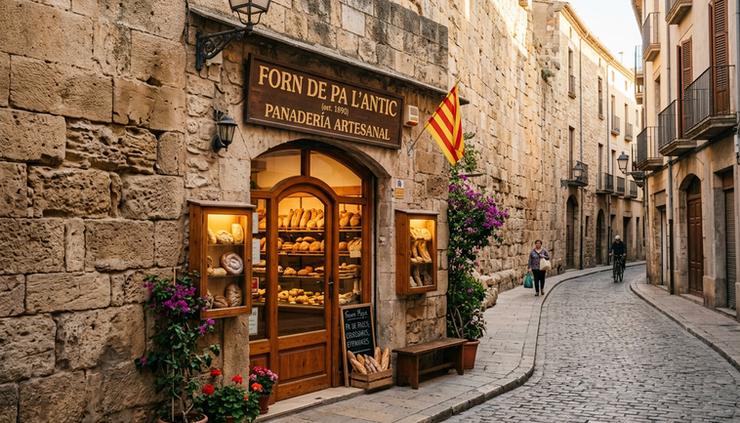
The bakery above the Roman circus in Tarragona still stays with me
Recently, I wrote about the bakery above the Roman circus in Tarragona. I keep returning to that image because it says everything I love about bread.
Tarragona is a city where history does not sit politely behind glass. Roman stones live beside daily life. You walk through the city and feel layers under your feet. The circus once held noise, speed, spectacle, animals, wheels, dust, and crowds. Centuries later, above that ancient place, bread rises.
That thought moves me.
The smell of a bakery is one of the most democratic pleasures on earth. It does not ask for your passport, job title, or education. It finds you in the street. Warm crust, toasted grain, yeast, smoke, sugar, butter, olive oil, maybe a tray of cocas or ensaïmadas nearby. The body understands before the mind has time to speak.
In Tarragona, the idea of bread above the Roman circus feels like a conversation between eras. Below, the remains of empire. Above, the daily miracle of flour, water, fire, and time. Stone and crumb. Monument and breakfast.
That contrast is powerful because bread does what monuments cannot. A monument preserves memory. Bread renews it.
Every morning, a baker repeats an act older than Rome. Older than Spain. Older than the languages we speak. The loaf comes out hot, and history becomes edible again.
The counterargument misses the point
Some people will say bread is ordinary. Too common. Too cheap. Too familiar to deserve this much attention.
I understand the argument. Bread is everywhere. Supermarkets stack it in plastic bags. Restaurants drop it on tables without ceremony. Many meals treat it as filler. Industrial bread can be soft, sweet, and forgettable. We have made bread so available that we sometimes stop seeing it.
But that is exactly why we should look again.
The ordinary things are often the most extraordinary because they carry the longest memory. Bread does not need luxury to matter. In fact, luxury can get in the way. A good piece of bread with olive oil can be more honest than a complicated dessert. A fresh roll eaten standing at the counter can stay in the mind longer than a formal meal.
The problem is not that bread is ordinary. The problem is that we have trained ourselves to confuse ordinary with disposable.
Good bread resists that. It asks us to notice crust, crumb, scent, temperature, chew, and grain. It asks us to slow down for a moment before swallowing. It asks us to honor the work behind it, from field to mill to bakery to table.
When bread is made with care, it is never background. It is presence.
Bread deserves ceremony, even on a normal day
I am not suggesting that every loaf must become sacred theater. Bread does not need candles and speeches. It needs attention.
Buy a loaf from a baker when you can. Tear it instead of always slicing it. Smell it before eating. Notice whether the crust snaps or bends. Taste it plain before covering it. Save what remains. Make breadcrumbs. Make soup. Make torrijas. Share the last piece.
These are small gestures, but they change the way food lives in a home.
At ARTESEROSTEK, that is the spirit we care about: the beauty of the made thing, the human story inside material, the link between hand, time, place, and memory. Bread belongs perfectly in that world. It is design before design. Craft before the word craft needed defending. Technology before technology became screens.
A loaf of bread contains a whole philosophy:
Take what the land gives.
Add water and patience.
Use fire with care.
Share the result.
Waste as little as possible.
Repeat tomorrow.
There is nothing primitive about that. It may be one of the most refined ideas humanity ever had.

Savor the 14,000-year-old miracle
Bread began before farming, crossed continents, entered religions, fed cities, survived wars, and still waits for us on the table. It can be a flatbread cooked on stone, a sourdough loaf, a tortilla, a pita, a baguette, a pan de payés, or my yaya’s torrijas soaking up cinnamon milk.
Its ingredients remain almost shockingly simple: flour, water, fire, and time.
Its meaning keeps growing.
Bread is proof that humans are not only hungry creatures. We are makers. We transform. We remember. We teach with our hands. We gather around warmth. We turn grain into food and food into belonging.
So the next time bread arrives at the table, pause for one breath before reaching for it. Look at the crust. Tear it open. Let the steam rise if it is still warm. Think of the first hands that crushed wild grain 14,000 years ago. Think of bakers above ancient stones in Tarragona. Think of grandparents saving yesterday’s loaf for tomorrow’s sweetness.
Then eat.
Because bread is not just old. Bread is alive each time we savor it. That is the ARTESEROSTEK spirit: to celebrate the quiet miracle in front of us, especially when it has been there all along.
FRANCO ARTESEROS:::...


Comments