
The Historical Evolution of Ocean Farming and Its Impact on Sustainable Agriculture

Ocean farming, also known as sea farming or mariculture, has grown from ancient coastal practices into a vital part of global food production. As the world faces increasing pressure on land resources and environmental challenges, ocean farming offers a promising path toward sustainable agriculture. This post explores the origins of ocean farming, its historical development, and how it shapes modern sustainable food systems.

Early Beginnings of Ocean Farming
The practice of cultivating marine life dates back thousands of years. Ancient civilizations living near coasts quickly realized the ocean’s potential as a food source beyond wild fishing. Early ocean farmers began by harvesting naturally growing seaweed and shellfish, gradually learning to cultivate them in controlled environments.
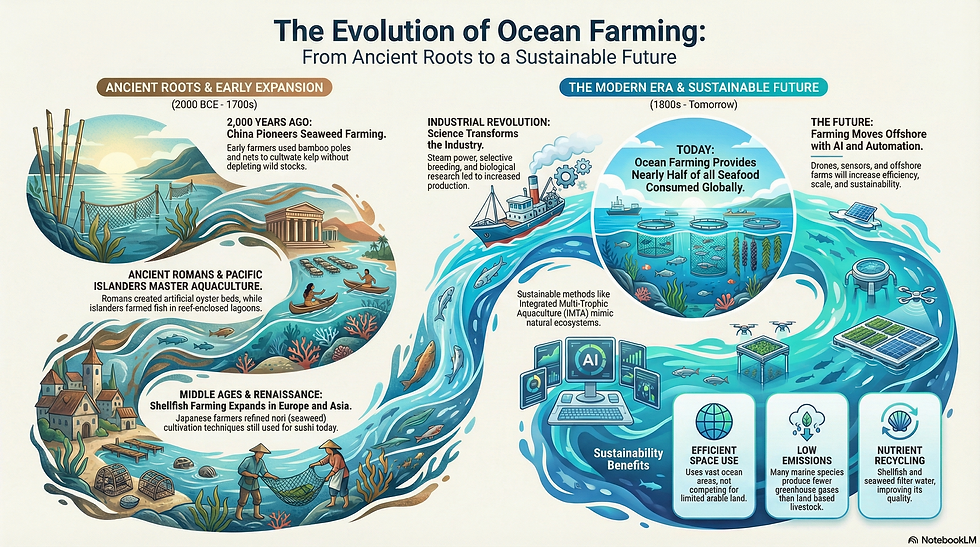
Ancient China: Around 2,000 years ago, Chinese communities developed some of the earliest documented seaweed farming techniques. They used bamboo poles and nets to grow kelp and other edible seaweeds in shallow bays. This method allowed them to harvest seaweed sustainably without depleting wild stocks.
Roman and Mediterranean Cultures: The Romans practiced oyster farming by creating artificial beds in coastal lagoons. They understood the importance of water quality and tidal flow for shellfish growth, laying the groundwork for modern aquaculture.
Pacific Islanders: Indigenous peoples in the Pacific Islands cultivated fish and shellfish in reef-enclosed areas. Their methods combined ecological knowledge with sustainable harvesting, ensuring long-term resource availability.
These early ocean farmers relied on observation and trial to develop techniques that balanced productivity with environmental health. Their practices were often integrated with local ecosystems, showing an early form of sustainable resource management.
Growth Through the Middle Ages and Renaissance
Ocean farming expanded in Europe and Asia during the Middle Ages and Renaissance periods. Coastal communities refined shellfish cultivation and began experimenting with fish farming.
Europe: Oyster and mussel farming became widespread along the Atlantic coasts. Farmers used wooden stakes and ropes to grow shellfish in estuaries and sheltered bays. These farms provided a steady supply of seafood to growing urban populations.
Japan: Japanese coastal farmers advanced seaweed cultivation, particularly nori (red algae). By the 17th century, they developed methods to seed and harvest nori sheets, techniques still used today in sushi production.
Middle East and North Africa: In the Mediterranean, fish ponds were constructed to raise mullet and other species. These ponds were connected to the sea, allowing water exchange and natural feeding.
During this period, ocean farming became more organized and commercialized. Coastal economies increasingly depended on marine agriculture, and knowledge spread through trade and cultural exchange.
Industrial Revolution and Technological Advances
The Industrial Revolution brought new tools and scientific understanding that transformed ocean farming.
Improved Infrastructure: Steam-powered boats and better transportation allowed farmers to access remote coastal areas and markets more efficiently.
Scientific Aquaculture: Researchers began studying marine biology and water chemistry, leading to better species selection and disease control.
Selective Breeding: Farmers started breeding shellfish and fish for desirable traits like faster growth and disease resistance.
New Species: The introduction of non-native species, such as Pacific oysters in Europe, expanded farming options but also raised ecological concerns.
These advances increased production but also introduced challenges. Overfarming and habitat disruption became issues in some regions, highlighting the need for sustainable practices.

Ocean Farming in the 20th and 21st Centuries
The 20th century saw ocean farming become a global industry. Rising demand for seafood, combined with overfishing of wild stocks, pushed governments and businesses to invest in aquaculture.
Global Expansion: Countries like Norway, Chile, China, and the United States developed large-scale fish farms, focusing on species such as salmon, shrimp, and tilapia.
Integrated Multi-Trophic Aquaculture (IMTA): This approach farms multiple species together, such as fish, shellfish, and seaweed, to mimic natural ecosystems and reduce waste.
Sustainability Focus: Environmental concerns led to stricter regulations and innovations to reduce pollution, escape of farmed species, and habitat damage.
Technological Innovations: Advances in water quality monitoring, feed efficiency, and genetic research improved yields and reduced environmental impact.
Ocean farming today plays a crucial role in feeding the world’s growing population. It provides nearly half of all seafood consumed globally and offers a more efficient protein source compared to land-based livestock.
The Role of Ocean Farmers
Ocean farmers are stewards of marine environments. Their work requires balancing productivity with ecosystem health. They manage:
Site Selection: Choosing locations with suitable water quality, currents, and minimal conflict with other uses.
Species Management: Selecting species that grow well locally and have market demand.
Environmental Monitoring: Tracking water conditions, disease outbreaks, and biodiversity impacts.
Harvesting and Processing: Ensuring seafood quality and safety for consumers.
Many ocean farmers collaborate with scientists and policymakers to develop best practices. Their knowledge combines traditional methods with modern science, making ocean farming a dynamic and evolving field.
Ocean Farming’s Impact on Sustainable Agriculture
Ocean farming contributes to sustainable agriculture in several ways:
Efficient Use of Space: Oceans cover over 70% of the Earth’s surface, offering vast areas for food production without competing for arable land.
Low Greenhouse Gas Emissions: Compared to cattle or crop farming, many marine species produce fewer emissions per kilogram of protein.
Nutrient Recycling: Seaweed and shellfish filter nutrients from water, improving water quality and reducing pollution.
Biodiversity Support: Well-managed farms can create habitats for wild species and enhance local ecosystems.
Food Security: Ocean farming diversifies food sources and supports coastal economies, especially in developing countries.
Despite these benefits, challenges remain. Ocean farming must address issues like disease management, genetic diversity, and potential ecosystem disruption. Continued innovation and regulation are essential to maximize positive impacts.

Looking Ahead: The Future of Ocean Farming
The future of ocean farming looks promising as new technologies and approaches emerge:
Offshore Farming: Moving farms further from shore to reduce conflicts and increase scale.
Automation and AI: Using drones, sensors, and machine learning to monitor and manage farms more efficiently.
New Species: Exploring farming of underutilized species like sea cucumbers, algae for biofuels, and marine plants for pharmaceuticals.
Circular Economy Models: Integrating ocean farms with land-based agriculture to recycle nutrients and reduce waste.
Community-Based Models: Empowering coastal communities to manage resources sustainably and benefit economically.
Ocean farming’s historical roots show a long tradition of adapting to environmental and social needs. Its future depends on balancing growth with care for the oceans that sustain it.
F.A :::...


Comments